
How to Choose a Hidden Microphone for Clear, Discreet Office Audio Monitoring
Choosing a hidden microphone for office use is not mainly about finding the smallest device or the most aggressive marketing claim. In real workplaces, the difference between a useful recording and a useless one usually comes down to speech intelligibility. You need to know whether the microphone will be close enough to the talkers, whether the room has hard reflective surfaces, whether HVAC noise will mask quiet voices, whether you can retrieve recordings safely, and whether live listening is actually necessary. A device that sounds impressive on paper can fail badly in a meeting room full of laptop fans, glass partitions and people who turn their heads while speaking.
This guide explains how to choose the right tool for office, meeting-room and desk-area audio monitoring without getting distracted by gimmicks. We will look at microphone type, transmission method, concealment strategy, battery planning, storage reliability and placement logic. If you are comparing the wider market of spy microphones, the right choice depends less on one headline specification and more on how the product fits the room, the workflow and the level of access you have after deployment.
What makes office audio harder than people expect
Many buyers assume office recording is easy because people speak indoors at short distance. In practice, offices are acoustically messy. Open-plan spaces create constant broadband noise from ventilation, keyboards, printers and distant conversations. Private offices may sound quieter, but they often have echoes from desks, windows and bare walls. Meeting rooms are worse when participants sit around a table and speak in different directions. A microphone hidden near one chair may capture one person clearly and everyone else poorly.
That is why the first buying question should be: what exact conversation are you trying to capture? If the target is a one-to-one discussion at a desk, a compact local recorder may be enough. If the goal is to monitor conversations throughout the day in a room you cannot re-enter often, a concealed mains-powered device may be more appropriate. If you need immediate awareness and cannot wait to recover files later, then a live-listening solution may be required, such as GSM spy microphones or WiFi spy microphones, depending on network access and range constraints.
Start with the real objective: recording evidence or listening live
Before comparing form factors, decide whether your priority is evidence preservation, live awareness, or a balance of both. This single decision eliminates many bad purchases.
When local recording is the better choice
Local recording is usually simpler, more discreet and more power-efficient. A device that records to internal memory or removable storage avoids the battery drain and signal dependency of continuous transmission. It can also reduce the risk of audio dropouts caused by weak connectivity. For many office scenarios, especially when you can retrieve the device later, dedicated voice recorders are the most rational option.
Local recording works best when you can place the microphone reasonably close to the expected speech zone, when you do not need to react in real time, and when you care most about obtaining a complete file rather than checking in remotely throughout the day. It is particularly useful for desk drawers, meeting-room accessories or items that can remain in place without drawing attention. A compact recorder such as the Pro X1 local spy recording microphone makes sense when simplicity, autonomy and file retrieval matter more than remote access.
When live listening is necessary
Live listening is the right choice when the value of the audio depends on immediate awareness. That may be because the conversation is time-sensitive, because you may need to verify the microphone is placed correctly, or because you are unable to retrieve the device quickly after use. Remote listening can be delivered through mobile networks, local WiFi networks or radio-based methods, but each comes with trade-offs.
GSM solutions are often easier to understand operationally: the device uses a SIM-based cellular link so you can monitor audio remotely without depending on the local office WiFi. In buildings where the local network is restricted or heavily monitored, that can be a major advantage. A practical entry point is browsing purpose-built live audio monitoring devices built for remote listening workflows.
WiFi solutions can deliver excellent convenience when you have stable access to the network and understand coverage limitations. They are especially useful in longer-duration indoor deployments where mains power is available. Devices disguised as familiar office electronics, such as a WiFi microphone charger, often fit naturally into desk or meeting-room environments where chargers and adapters are already common.
Concealment in an office is about context, not just size
People often overvalue small dimensions and undervalue contextual camouflage. In an office, the best hidden microphone is rarely the tiniest one. It is the one that belongs visually, functionally and behaviorally in the environment. A device hidden inside a normal object can be more effective than an ultra-miniature module if the larger object gives you better microphone placement, longer power life and less suspicion.
This is why many buyers begin with the category of concealed spy microphones. The category is broad because office environments are broad: private offices, reception desks, conference rooms, waiting areas and home-office spaces all have different concealment opportunities. The right disguise should match the room’s normal contents. A device that makes sense in a lounge may look absurd on an accountant’s desk, while a charger, router, clock or desk accessory may look completely ordinary.
Good concealment objects for offices
In desk-oriented rooms, office accessories usually provide the most natural camouflage. Examples include chargers, power strips, clocks, calculators, lamps and network devices. What matters is not novelty but normalcy. If every workstation already has charging hardware, adding one more charger-shaped device creates little visual friction. If there is a shared meeting room with a wall clock and a power strip near the table, those objects can offer both concealment and practical placement height.
For office audio, the right hidden microphone is the one that matches the room, the conversation pattern and your access after placement. Clear speech usually depends more on placement logic, power strategy and whether you need live listening or local recording than on headline specs alone.

For example, a charging station hidden microphone can blend into executive desks or conference tables where people expect phones and accessories to be charged. A wall clock hidden microphone may work well in a meeting room when broad ambient pickup is acceptable and line-of-placement above the table improves coverage symmetry. In a network-heavy office, a router-style hidden microphone can look entirely ordinary among cables, switches and telecom equipment.
Bad concealment choices
A poor disguise is one that attracts attention because it is out of place, oddly positioned or inconsistent with the company’s style. Decorative items can fail in minimalist offices. Personal accessories can fail in shared rooms where nobody can plausibly own them. A hidden microphone disguised as a whimsical home object may stand out in a legal, medical or corporate setting. Concealment should always be evaluated against room function, decor standards, cleaning routines and the likelihood that someone will move or unplug the object.
Placement matters more than advertised sensitivity
Hidden microphone listings often mention long pickup distances, but distance on its own is misleading. Speech clarity depends on the ratio between the wanted voice and the competing noise around it. Every extra meter increases the share of room sound, reflections and background hiss relative to the direct voice. In an office, even a technically sensitive microphone can produce muddy results if placed too far from the speaking zone.
The practical rule is simple: place the device as close as possible to the most important voices while preserving concealment. On a desk, closer is almost always better than higher. In a meeting room, central placement can outperform corner placement because it reduces distance variance between participants. Against a wall, a microphone may receive more reflections than direct speech unless the speakers are nearby.
Desk conversations
For one-person or two-person desk conversations, objects located on or just above the desk often provide the best balance. Chargers, calculators, lamps and power accessories work because they sit near mouths without looking abnormal. A calculator covert microphone can make sense in administrative, logistics or finance environments where calculators remain common. Likewise, a desk lamp hidden microphone can place the microphone capsule above the work surface while still remaining believable in an office corner or workstation.
Meeting tables
In a meeting room, one of the biggest mistakes is placing the device on the room perimeter and expecting clear speech from all participants. If you need balanced capture from several people, the microphone should be hidden as near to the table center as the disguise allows. A power accessory, charging hub or tissue box may work better than a wall-mounted object because it reduces average distance. A tissue box hidden microphone can suit informal meeting areas, while a power strip hidden microphone can fit rooms where participants plug in laptops during presentations.
Adjacent-room listening
If the microphone cannot be placed inside the room at all, the task changes completely. Recording through a wall, partition or structural surface requires equipment built for vibration transfer rather than airborne speech alone. Standard concealed microphones are not ideal for this. Instead, you should look at specialist wall microphones designed to pick up vibrations passing through surfaces. A contact microphone for vibrations may help when the structure transmits usable energy, but expectations must remain realistic because wall construction, background vibration and surface coupling heavily affect results.
Choosing by office scenario
The easiest way to avoid buying the wrong device is to match the microphone to a precise office scenario instead of shopping by gadget type.
Private office with occasional access
If you can enter the room occasionally and retrieve the device after a key meeting, local recording often wins. You avoid network dependency and maximize recording simplicity. Choose a disguise that belongs permanently in the room, such as a clock, charger or desk object. Prioritize low self-noise, enough memory for the expected duration and a placement zone within a few meters of the conversation area.
Meeting room with continuous power available
Where mains power is available and the room hosts repeated discussions, mains-powered concealed devices are efficient because they reduce battery risk. Chargers, wall outlets, routers and power strips can remain in place for long periods with minimal handling. A wall outlet listening device may suit rooms where electrical fixtures are stable and rarely moved. If remote monitoring is needed and WiFi access is dependable, a device such as a WiFi power strip microphone with remote access can be particularly practical.
Temporary pop-up workspace or shared office
In temporary spaces, concealment must tolerate movement, cleaning and casual inspection. Portable disguised devices may be more suitable than fixtures that require semi-permanent installation. Bags, power banks and everyday carry items can help when the environment changes frequently, but the microphone still needs a credible reason to be there. A WiFi power bank microphone can fit mobile and flexible office use where charging accessories are normal and repositioning may be necessary.
Executive office or formal boardroom
In offices, concealment works best when the object feels normal for the exact room and stays close to the speech zone. A believable placement usually delivers better audio than a smaller device hidden in the wrong location.
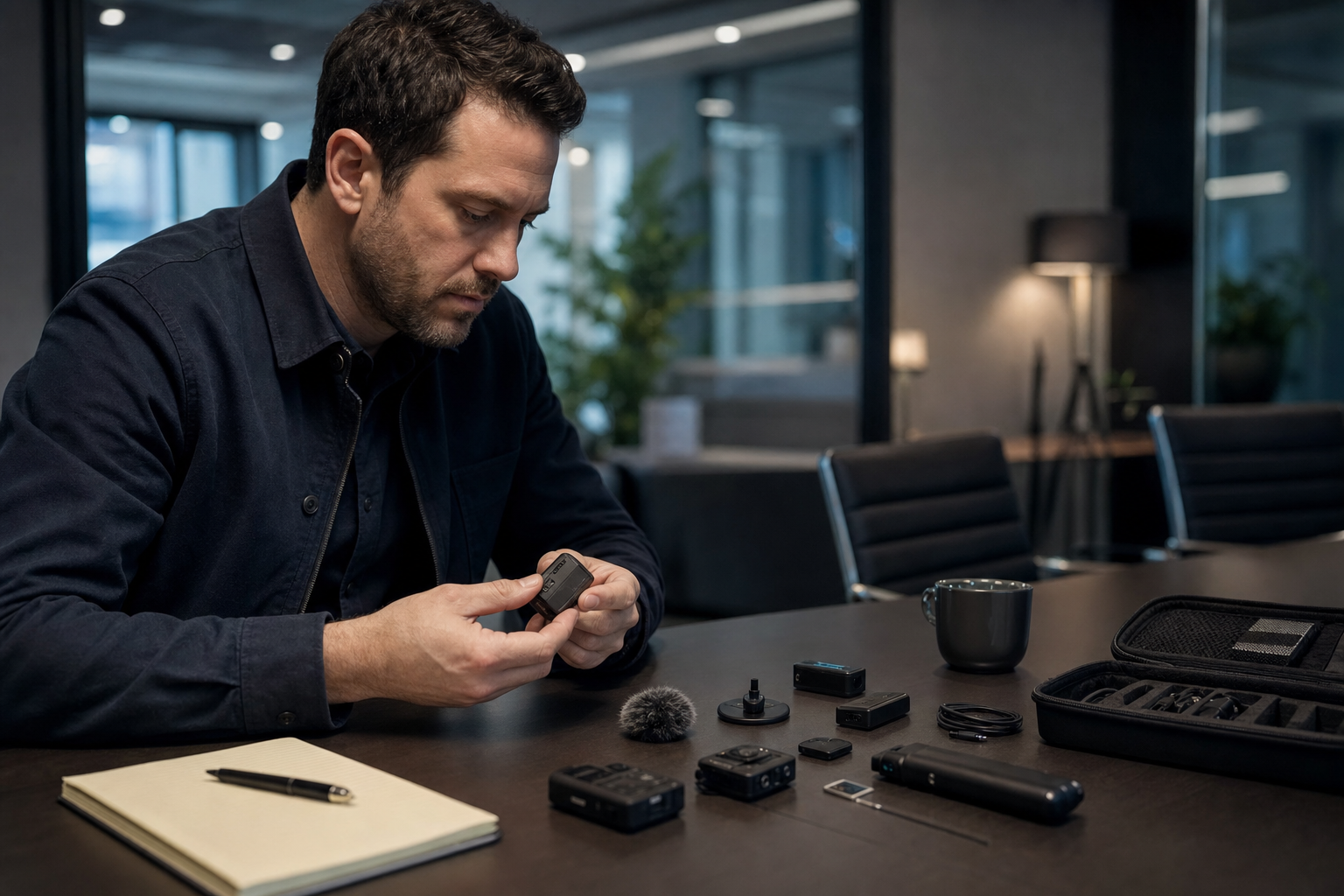
High-end environments require especially careful disguise selection. Cheap-looking novelty items may stand out immediately. In these rooms, form factors should align with premium decor and low clutter. Clocks, power accessories, network hardware and subtle desktop devices usually integrate better than playful objects. Audio expectations should also remain conservative because large conference tables increase distance dramatically. In many boardrooms, one strategically placed device near the center captures more intelligible speech than a more expensive device hidden in the corner.
WiFi vs GSM for office monitoring
Buyers often ask which is better: WiFi or GSM. The correct answer is contextual.
Why WiFi can be ideal indoors
WiFi-based microphones are attractive in office buildings because indoor wireless coverage is often strong, and the devices can be reached without a SIM card voice workflow. They may be well suited to long-term indoor use, especially when disguised as network or charging equipment. A simple option such as the Pro W2 WiFi microphone with live listening can fit rooms where signal coverage is stable and you need remote access without relying on local file recovery.
However, WiFi assumes workable network conditions. Enterprise environments may isolate guest devices, rotate credentials, restrict unknown hardware or monitor network activity closely. If you cannot reliably connect and maintain access, WiFi convenience disappears quickly.
Why GSM can be more independent
GSM avoids dependence on the office network. That makes it useful when WiFi credentials are unavailable, unstable or risky to use. It can also help in buildings where the device may need to be accessed from outside without any local IT configuration. A practical example is the USB charger with hidden GSM microphone, which suits environments where charger-shaped electronics blend in naturally while mobile connectivity provides independent reach.
The downside is that cellular reception inside some office cores can be weak, especially in basements, reinforced buildings or shielded areas. GSM devices also require you to think about SIM management, coverage quality and sometimes audio latency. Independence is valuable, but only if the signal is actually usable where the device will operate.
Battery life, mains power and operational reality
Power planning is one of the most common reasons office monitoring deployments fail. Buyers focus on the moment of installation but forget the full recording window. If a meeting might start two hours late, a device advertised for a short active duration could die before the important conversation begins. Likewise, a voice-activated mode may help extend life, but if the office has continuous ambient noise, the device may remain awake more often than expected.
Battery-operated devices are useful when mobility and concealment flexibility matter. Watches, pens, keychains and portable objects can be effective in short deployments or situations where the device will travel with the carrier. But in fixed office spaces, mains-powered objects often provide a much safer operational profile because they remove autonomy as the main point of failure.
For wearable or highly portable use, a product like the spy pen microphone recorder may be practical for meetings, interviews or ad hoc recording where manual carry and later retrieval are expected. For longer stationary use, mains-disguised products usually offer better stability and less maintenance.
Storage, file integrity and retrieval workflow
A hidden microphone is only useful if you can reliably recover and understand the audio afterward. Storage capacity matters, but so do recording mode, file segmentation, timestamps and the ease of transferring files without damaging evidence value. In office settings, retrieval workflow should be planned before deployment. If the device is difficult to access discreetly, local recording may become less attractive unless the autonomy and storage are very generous.
When comparing devices, ask practical questions. Does the unit record continuously or only on sound activation? Are files split into short segments? Is memory internal or removable? Can you verify the clock and file sequence easily? How quickly can you extract the files and duplicate them safely? For buyers still comparing broad options, the new spy microphone releases section can be useful for spotting newer devices that improve storage handling, remote access or form-factor quality.
Also remember that storage efficiency does not compensate for poor placement. Hundreds of hours of badly captured room noise are less valuable than thirty minutes of well-placed, intelligible speech.
Specialist microphones for unusual office tasks
Most office buyers should focus on concealed microphones, local recorders or WiFi/GSM devices. But some scenarios require specialist tools.
Wall microphones for neighboring rooms
As noted earlier, adjacent-room listening is a structural-vibration problem, not a standard desk-recording problem. Professional wall microphones can help when the goal is to monitor conversations through a partition, door frame or wall surface and when direct placement inside the room is impossible. A more advanced option such as the professional wall microphone V3 is relevant only when the scenario genuinely requires through-structure listening and the user understands its limitations.
Parabolic microphones for outdoor-to-indoor or distance tasks
Parabolic microphones are not normal office tools, but they can matter in external observation scenarios where the listener must remain at a distance and capture directional sound from a target area. They are generally unsuitable for conventional room placement because they are directional and visually specialized. If the task involves remote directional listening around property approaches or from a vehicle outside a building, explore parabolic microphones rather than forcing a concealed office device into the wrong role.
Laser microphones for line-of-sight vibration capture
Laser microphones are even more specialized and should not be confused with plug-and-play hidden office devices. They are designed for long-range vibration-based audio capture from surfaces such as windows, under the right conditions and with the right expertise. For standard office buyers, they are usually excessive. Still, if your use case truly involves standoff optical listening rather than object concealment, the relevant category is laser microphones, not desk disguises or portable recorders.
WiFi, GSM, battery power and storage only work well when they fit the building and the real operating window. In most office cases, dependable access, stable power and a practical retrieval plan matter more than feature density.

How to judge product form factors intelligently
When choosing between disguised products, do not compare them only by appearance. Think through the hidden engineering consequences of the form factor.
Chargers and power accessories
These are often excellent in offices because they naturally remain plugged in, sit near desks and meeting tables, and do not need regular battery handling. They may also allow longer remote operation. Their weakness is that they can be unplugged by cleaning staff or replaced if the office standardizes equipment tightly.
Clocks and wall objects
These provide good visual camouflage in some rooms and can stay in place for long periods. But they may be farther from speech than desk-level devices, which reduces clarity. Use them when broad ambient coverage is acceptable, not when you need every quiet sentence to be crisp.
Portable wearables and carry items
Watches, pens, keychains and bags can be useful when the device must enter and leave with a person. They can also solve concealment problems in temporary office settings. But because they move, rustle, rotate and change distance from speakers, audio consistency may be worse than with a stable fixed object.
Examples include wearable-style items such as the Delta spy microphone watch for highly portable use, or room-stationary decor objects like the artificial plant hidden microphone for lounge-style office corners where decorative elements are already present.
Office audio quality checklist before you buy
Use the following checklist to narrow your decision:
1. How close can the microphone be to the main speakers?
If the answer is within one to three meters, many concealed devices can work well. If it is farther, intelligibility becomes much harder and you may need a different placement strategy rather than a more expensive product.
2. Do you need live listening or only a reliable recording?
If there is no need to react in real time, local recording is often the cleaner and safer choice.
3. Is mains power available?
If yes, disguised mains-powered objects are often the most reliable office solution. If not, battery planning becomes critical.
4. What objects naturally belong in the room?
Choose a disguise that fits the office’s normal visual language. A charger, clock, router or desk item may be ideal depending on the environment.
5. Will anyone move, unplug or inspect the object?
A perfect-looking disguise still fails if it gets picked up, borrowed, cleaned around aggressively or replaced by facilities staff.
6. How and when will you retrieve or access the audio?
Do not deploy first and solve workflow later. Plan file recovery, remote access testing and time synchronization in advance.
Common buying mistakes for office hidden microphones
Buying by range claim alone
No single “range” figure guarantees clear speech in offices. The room and placement geometry matter more.
Choosing the smallest possible device
Ultra-miniature devices can be difficult to place, power and retrieve. A slightly larger disguised object may perform far better.
Ignoring room noise
Air conditioning, office machinery and corridor traffic can ruin quiet recordings. Think about the noise floor before expecting clear speech.
Using the wrong transmission method
WiFi is not always easier, and GSM is not always stronger. Match the method to the building and access constraints.
Forgetting the retrieval plan
Many local-recording deployments fail because the user cannot discreetly recover the device or the files when needed.
A smart shortlist for most office buyers
If you want a practical buying path, build your shortlist around three branches.
First, if you want the simplest and often most reliable approach for short or medium deployments, start with local audio recorders for office speech capture. Second, if you need remote access inside a building with dependable network conditions, review WiFi listening devices for indoor monitoring. Third, if independence from the office network matters most, compare cellular live-listening microphones.
If your priority is broad browsing by concealment style, the fastest route is the larger family of hidden microphones disguised as everyday objects. And if budget is part of the equation, the spy microphones on sale page can help identify lower-cost options without losing sight of the deployment logic explained here.
Final advice: choose for intelligibility, not novelty
The best hidden microphone for an office is the one that captures understandable speech in the actual room where it will be used. That usually means choosing a device that matches the environment, sits close to the speakers, has a realistic power strategy, and fits your retrieval or live-monitoring workflow. Novel disguises, dramatic range claims and overcomplicated features are secondary.
If you think like an acoustics planner rather than a gadget shopper, your choices become clearer. Start with the room, the voices, the access constraints and the required response time. Then choose the appropriate class of device, whether that is a local recorder, a disguised mains-powered unit, a WiFi model or a GSM remote-listening solution. In office monitoring, quiet competence beats flashy specifications almost every time.
The smartest office choice usually comes from balancing form factor, placement, power and retrieval instead of chasing novelty. If the device belongs in the room and captures intelligible speech reliably, it is usually a stronger option than a more exotic model.
Frequently Asked Questions
What matters most when choosing a hidden microphone for an office?
The main priority is usually speech intelligibility, not the smallest size or the boldest product claim. In office settings, clear results depend on how close the microphone is to the speakers, how noisy or reflective the room is, how recordings will be retrieved, and whether live listening is truly necessary. A device that looks impressive on paper can still perform poorly in real workplace conditions.
Why is office audio recording often harder than people expect?
Offices may seem easy because conversations happen indoors, but they are often acoustically difficult. Open-plan areas add ventilation noise, keyboards, printers and distant voices. Private offices can create echoes from windows, desks and bare walls. Meeting rooms are especially challenging when people sit around a table and speak in different directions, making balanced capture much harder than expected.
Should I choose local recording or live listening for office monitoring?
It depends on your real objective. If you mainly want to preserve a complete recording and can retrieve the device later, local recording is usually the better fit. If immediate awareness matters, if you need to confirm placement, or if quick retrieval is not possible, live listening may be more appropriate. Deciding this first helps avoid unsuitable purchases.
When is local recording the better option in an office?
Local recording is usually best when you can place the microphone near the expected speech area and recover the device afterward. It is simpler, more discreet and more power-efficient because it avoids continuous transmission. It also reduces the risk of audio dropouts caused by weak connectivity, making it a practical choice for desks, meeting-room accessories and similar placements.
When is live listening necessary for office audio monitoring?
Live listening makes sense when the value of the audio depends on immediate awareness. That can happen when a conversation is time-sensitive, when you want to verify that placement is correct, or when you cannot retrieve the device quickly after use. In those cases, remote listening may be more useful than waiting to recover stored files later.
What is the difference between GSM and WiFi hidden microphones for office use?
According to the source, GSM devices use a SIM-based cellular link, which allows remote monitoring without relying on the office WiFi. That can be useful when local networks are restricted or closely monitored. WiFi devices can be very convenient when you have stable network access and understand the coverage limits, especially in longer indoor deployments with mains power available.
Is the smallest hidden microphone always the best choice for an office?
No. In an office, contextual camouflage usually matters more than ultra-small size. The most effective device is often the one that visually and functionally belongs in the room. A larger object that looks normal may provide better placement, longer power life and less suspicion than a tiny device that is harder to position well or easier to notice as unusual.
What kinds of objects work well for concealing a microphone in an office?
The source highlights common office items such as chargers, power strips, clocks, calculators, lamps and network devices. These work because they fit naturally into desk areas, meeting rooms or network-heavy spaces. The key is normalcy: the object should match what people already expect to see in that room rather than standing out as decorative, unusual or inconsistent with the environment.
What makes a concealment choice look suspicious in a workplace?
A disguise becomes a bad choice when it looks out of place, is positioned oddly, or does not fit the company style. Decorative or whimsical objects can fail in formal settings, and personal-looking items may not make sense in shared spaces. The source also stresses checking whether cleaning routines, room function or the chance of someone moving or unplugging the object could expose it.
How important is placement compared with advertised pickup distance?
Placement is more important than advertised sensitivity or long-distance claims. In an office, every extra meter adds more room noise, reflections and background sound compared with the direct voice. Even a sensitive microphone can produce muddy audio if it is too far away. The practical rule given is to place the device as close as possible to the key voices while keeping the concealment believable.
Where should a hidden microphone be placed for desk conversations?
For one-person or two-person desk conversations, the source recommends objects located on or just above the desk. Chargers, calculators, lamps and power accessories often work well because they can sit close to where people speak without looking unusual. In this setting, closer placement usually gives a better balance between discreet concealment and clearer voice capture.
What is the best placement approach for a meeting room?
The source warns against placing the device on the room perimeter and expecting clear capture from everyone. For several participants, the microphone should be hidden as close to the table center as the disguise allows. Central placement reduces distance differences between speakers, which usually gives more balanced results than a corner or wall position.
Can a standard concealed microphone record conversations from an adjacent room?
The source says this is a different task entirely. If the device cannot be placed inside the room, standard concealed microphones are not ideal because they are designed for airborne speech. In that situation, you should look at specialist wall microphones or contact microphones for vibrations, while keeping expectations realistic because wall structure and background vibration strongly affect performance.
What is a good hidden microphone setup for a private office with occasional access?
If you can enter the room from time to time and retrieve the device after an important meeting, local recording is often the most practical option. The source recommends using a disguise that can naturally remain in the room, such as a clock, charger or desk object. It also suggests prioritizing low self-noise, enough memory and placement within a few meters of the conversation area.
What works best in a meeting room with continuous power available?
Where mains power is available, concealed devices that can stay connected are efficient because they reduce battery-related risk. The source points to chargers, wall outlets, routers and power strips as practical forms that can remain in place with little handling. If remote monitoring is also needed and WiFi access is reliable, a WiFi-based mains-powered option can be especially convenient.
What should I consider for a temporary workspace or shared office?
In temporary or shared spaces, the source says concealment must withstand movement, cleaning and casual inspection. Portable disguised devices may be more suitable than fixtures that depend on semi-permanent installation. The object still needs a credible reason to be present, so everyday carry or charging-related items may fit better in flexible office environments where layouts change often.