
How to Find Passive, Wired and Dormant Surveillance Devices That RF Scanners Can Miss
Many people start a counter-surveillance search with one assumption: if a hidden device is present, it will transmit a signal. That assumption is understandable, because WiFi cameras, Bluetooth accessories, cellular trackers and wireless bugs can all leave radio-frequency traces. It is also incomplete. A camera may record only to a memory card. A microphone may be hard-wired into a room, connected to a recorder elsewhere, or wake only at scheduled intervals. A tracker may stay silent while parked and report only after movement. A device may be powered down, depleted, unplugged, shielded by its installation position, or deliberately configured to transmit very briefly.
That is why a credible inspection cannot be reduced to walking through a room with an RF detector and reacting to every spike. A reliable search is a layered investigation: first understand the space and its normal systems, then inspect likely access and concealment points, observe radio activity over time, look for optical evidence, trace power and cabling, and escalate to specialist electronics detection when the risk justifies it. The aim is not to prove that a room contains no conceivable device. The aim is to reduce uncertainty methodically, identify anomalies that deserve attention, preserve the evidence of a genuine discovery, and make an informed decision about next steps.
This guide focuses on the blind spot of radio-only searches: passive, wired, dormant and intermittently transmitting surveillance devices. It is useful for authorised inspections of homes, meeting rooms, offices, short-term accommodation, vehicles and sensitive work areas. Always respect applicable law, property rights, employment rules and privacy obligations. In a serious corporate, legal, personal-safety or criminal matter, involve qualified counter-surveillance and legal professionals rather than altering a suspected device yourself.
Why RF scanning alone cannot clear a room
An RF detector measures radio energy, not intent. When it alerts, it may be responding to a legitimate router, phone, smart television, wireless alarm sensor, smartwatch, vehicle key, cordless peripheral or nearby external transmitter. Conversely, a quiet detector does not establish that no surveillance hardware exists. It establishes only that the detector did not observe a sufficiently strong, relevant transmission in its coverage range during that particular test condition.
Several common device architectures explain this limitation. A local-recording camera can store video internally without using WiFi. A miniature audio recorder can capture sound for later retrieval without broadcasting at all. A wired microphone can run through a ceiling void, conduit, furniture panel or network cable to recording equipment in another area. A battery device can operate on a timer, voice trigger, motion trigger or remote command. A cellular tracker can conserve power by sleeping for long periods, then send a compact location report after movement. Even a device designed for live transmission may stop transmitting if its battery is flat, its network is unavailable, its operator has disabled it, or its signal is hidden beneath normal wireless activity.
For this reason, signal detectors are best understood as one important layer in a broader process. They are valuable for discovering active emitters and comparing suspicious activity against a baseline, but they cannot see a passive lens, a disconnected recorder, a wired capsule microphone or an inactive tracker by themselves. A good investigator treats a detector alert as a lead to test, not as a verdict.
Begin with a threat model, not a tool
The first question is not which detector to buy. It is what kind of access, motive and opportunity are plausible in the environment. A hurried hotel-room check has a different goal from an annual boardroom audit. A vehicle used by several drivers has different vulnerabilities from a private study. A contested workplace issue may require a defensible, documented inspection by an independent professional, while a homeowner checking a newly acquired property may be focused on obvious unwanted devices and unsafe alterations.
Define the asset to protect: confidential conversations, visual activity, travel patterns, access codes, business documents, personal safety or a specific event. Next, identify who could have had access and for how long. Permanent physical access creates opportunities for hard-wired devices, modifications behind panels and concealed power connections. Brief access more often favours portable, self-powered items, plug-in devices or equipment placed in plain sight. Consider whether the suspected observer needs live information or could retrieve recorded material later. This distinction changes the search priorities dramatically.
Also define the inspection boundary. A room rarely ends at its walls. Relevant paths may include adjoining rooms, shared ceiling voids, utility closets, ventilation routes, shared electrical circuits, parking areas, vehicle exterior panels and cloud-connected devices controlled from elsewhere. Write down what is in scope before starting. That simple discipline prevents a common failure: finding an unusual item but having no record of whether it was present before the inspection, who had access, or which adjacent spaces could support it.
Match the search method to the likely device behaviour
If the concern is live audio interception, prioritise active RF observation, common power sources, network equipment and acoustic access paths. If the concern is covert video, add an optical lens search, a review of sight lines, darkened-room reflection testing and inspection of objects facing beds, desks, entrances, safes or work surfaces. Where vehicle tracking is suspected, physical mounting logic, wiring routes and movement-dependent testing matter more than a quick stationary scan. For persistent high-value threats, add a detailed inspection for electronic components whether or not they are currently powered.
The broader counter-surveillance equipment guide can help place each technology in context. The essential point is that no single tool can validate every device type. The strongest outcome comes from combining tools with careful observation, repeatable notes and a realistic understanding of each tool's limits.
Build a baseline before treating anything as suspicious
Modern rooms are noisy environments. A smart speaker, mesh router, printer, television, charging hub, voice assistant, wireless presentation system, lighting bridge, alarm panel and personal phone can all look suspicious if you do not know they belong there. The same is true in vehicles, where telematics modules, tyre-pressure sensors, Bluetooth systems, keyless-entry electronics and factory-installed antennas can complicate a search.
Start by listing ordinary equipment, locating the router and network extenders, identifying permanently installed cameras and documenting chargers, adapters, plugs and cables. Where authorised, disconnect or switch off non-essential wireless equipment one item at a time and observe what changes. This is not merely an RF exercise. It narrows the room's complexity, reveals unknown power dependencies and reduces the chance that you mistake your own technology for an intrusion.
RF scanning is valuable for finding active transmitters, but it cannot rule out local-recording, wired, dormant or shielded devices. Start with a realistic threat model and a documented baseline so that physical and electronic anomalies can be assessed in context.
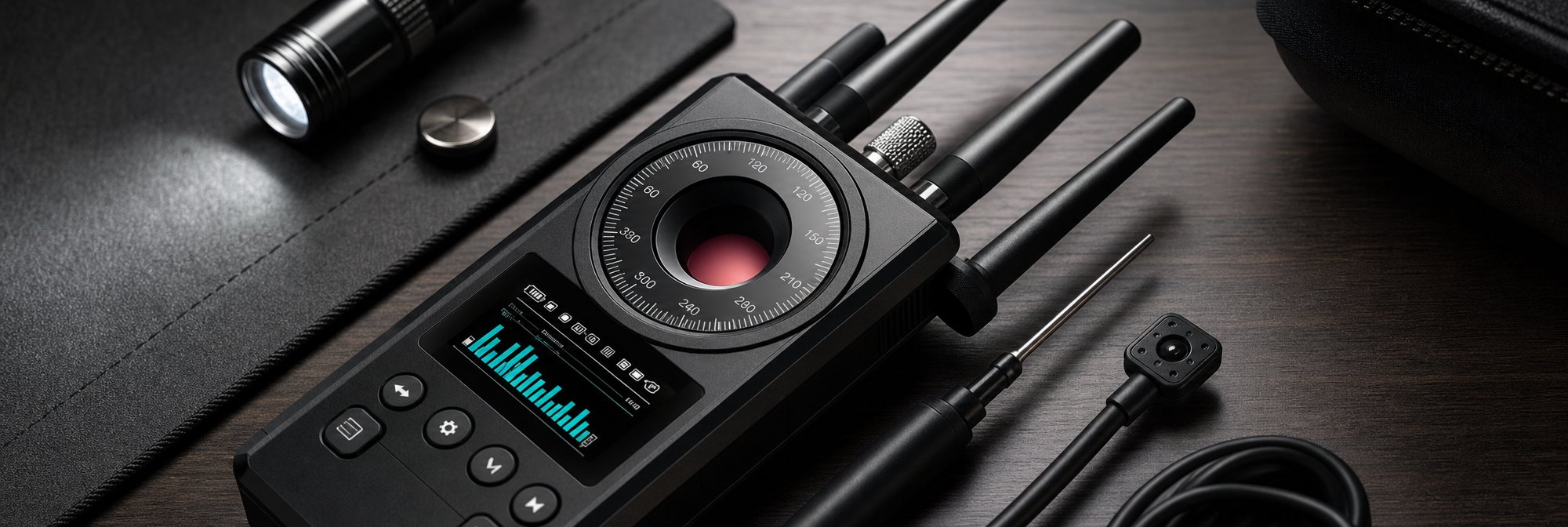
A written baseline should include date, time, location, occupants, devices known to be active, wireless networks observed, unusual objects, existing damage and photographs of significant areas. In a recurring inspection programme, compare each new baseline with the previous one. A new charger, cable route, ceiling mark, access-panel screw, wall plate, furniture modification or wireless device is not proof of surveillance, but it is a concrete change that can be assessed rationally.
For connected homes and hybrid workplaces, use a repeatable counter-surveillance baseline for smart spaces rather than relying on memory. Consistency is what makes anomalies visible. A person who knows what should be present is far less likely to be overwhelmed by normal technology or reassured too quickly by a quiet scan.
Inspect the physical environment in a deliberate sequence
Physical inspection is where many non-transmitting devices are found. The challenge is not to search randomly. Divide the area into zones and inspect them in the same sequence every time. A practical order is entry points and sight lines, power and communications infrastructure, furnishings and decorative objects, ceilings and walls, service voids, then adjacent or exterior access points. Work from broad observations to close examination. Photograph the original condition before moving items whenever evidence may matter.
At the doorway, ask what can be seen or heard from each plausible concealment location. A device needs a useful view, acoustic path, cable route, power source or future retrieval path. An object hidden deep inside a cabinet may be less relevant than an ordinary-looking item facing a desk, bed, conversation area, safe or entrance. Conversely, an object may be placed solely to capture sound, in which case a clear line of sight is unnecessary but proximity to speech and access to power become more important.
Look for mismatched finishes, fresh adhesive, disturbed dust, unaccountable holes, recently painted patches, loose trim, unusual screws, duplicate objects, cables that do not lead to an identifiable function, warm power adapters, unknown chargers, modified wall plates and furniture that seems oddly positioned. Do not equate unusual with malicious. Hotels, offices and vehicles often contain imperfect repairs. The relevant issue is whether several indicators form a plausible device story: access, concealment, power, communication and a useful collection position.
Power-path analysis: follow the electricity
Passive recording still requires energy unless a device is genuinely unpowered. Therefore, power-path analysis is one of the highest-value ways to find hidden electronics. Identify every outlet, USB supply, extension lead, power strip, charger, battery pack, lighting fixture, smoke alarm, network switch and mains-powered decorative item in the inspection area. Ask what it powers and whether its current rating, heat, cable routing and placement make sense.
Be especially cautious around mains electricity. Do not open live electrical fittings, probe conductors or remove installed components unless you are qualified and authorised to do so. The safer first step is visual comparison: do wall plates match? Are screws consistent? Does a cable enter a void without an obvious destination? Is an adapter unusually large, permanently installed or connected to nothing visible? Electrical infrastructure can also be shared across rooms, so an unexplained cable may require property-management records or professional inspection rather than immediate dismantling.
Power analysis also applies to battery devices. Inspect items that are unusually heavy, have unexplained charging ports, require frequent repositioning, or appear to be placed for observation rather than ordinary use. Check whether batteries, memory cards or charging leads have been left where they could support a device. A dormant recorder may reveal itself through an inconsistent object design, not through RF activity.
Trace cables and inspect inaccessible voids safely
Wired devices tend to leave a route: a cable, conduit, ceiling penetration, duct, trunking channel, altered panel or connection box. Do not pull unknown wires. Instead, document their visible route and determine whether they correspond to legitimate installations such as security systems, audiovisual equipment, fire alarms, access control or network services. In offices, facilities teams may hold drawings that explain routes that otherwise look suspicious.
When a visual path enters a narrow cavity, an authorised visual inspection can be more informative than blind disassembly. Purpose-built inspection endoscopes can help examine voids, furniture cavities, ceiling spaces and difficult-to-reach installation areas while minimising damage. Use adequate lighting, move slowly and record the location and orientation of each observation. An endoscope does not identify intent; it helps establish whether a cable, component, lens opening or foreign object is actually present.
Any discovery inside a building system should be handled carefully. A suspected device may be part of a lawful alarm, communication or environmental-control installation. It may also contain evidence, fingerprints, data or wiring information that is lost when moved. Isolate the area if safety permits, photograph the discovery in place, record the time and contact the appropriate owner, investigator or professional.
Use optical methods to search for cameras that never transmit
A camera that records locally can be completely invisible to RF tools. Optical inspection is therefore essential whenever visual surveillance is a concern. Begin by mapping the sensitive scene: sleeping areas, changing spaces, workstations, doors, cash points, document tables, entry corridors and locations where a person naturally expects privacy. From each likely camera position, consider whether a small lens could obtain a meaningful image through a gap, grille, aperture or reflective surface.
Look at objects rather than only looking for obvious cameras. Clocks, detectors, chargers, decorative items, ventilation grilles, shelving, picture frames, lamps, media equipment and vehicle trim can all contain apertures or be positioned to create a view. The most useful visual question is simple: does this object have a plausible everyday function, and does its orientation make sense? A harmless sensor may have a clear operational purpose; a suspicious device often combines an unexplained opening with a strategically useful angle.
Low-angle lighting and controlled reflection checks can help reveal a lens, but they are not infallible. Lens glass can be tiny, recessed, covered, angled, dirty or absent from a device intended only for audio. Reflections from screws, glossy plastic, LEDs and metal trim create false positives. Use an observation as a lead for closer inspection, not as proof. For a structured room-by-room process, consult this hidden camera detection method with fewer false alarms.
A deliberate physical inspection often reveals what RF tools cannot: implausible power arrangements, unexplained cable routes and objects placed for a useful view or listening position. Treat individual clues as leads, document them carefully and inspect fixed infrastructure only within your authority and competence.
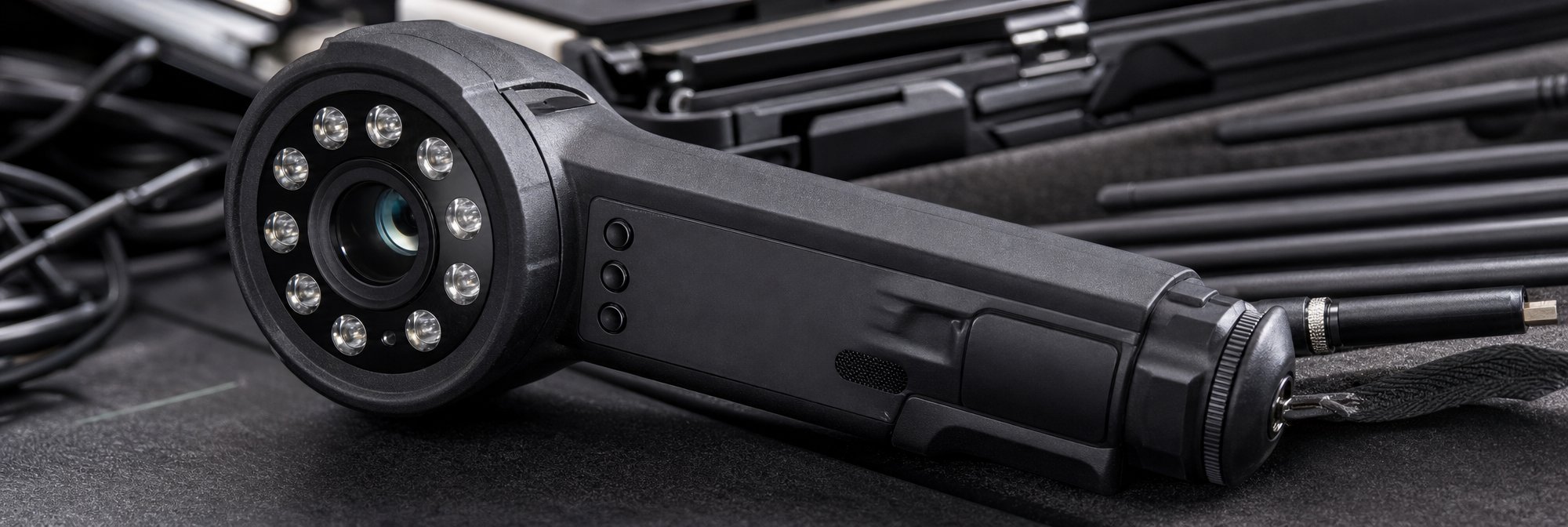
Dedicated spy camera detection tools can support visual and lens-reflection checks, particularly in cluttered spaces where unaided observation is difficult. Their effectiveness depends on the camera's lens geometry, distance, concealment, lighting and the operator's technique. They complement a physical search; they do not replace it.
Observe RF behaviour over time instead of chasing every alert
Although this guide focuses on devices RF scanners can miss, RF observation still has a central role. The key is to test behaviour. Scan with normal room equipment active, then reduce known sources where permitted. Observe whether a signal is continuous, periodic, movement-related, voice-related or linked to one particular object. Check whether the reading changes when you move closer, shield an item temporarily with an appropriate authorised method, disconnect a known device, or move the detector through different areas.
A meaningful result is repeatable and localised. If an indication appears only near a router, it may be expected. If it appears only when an unexplained object is powered, is strongest at that object and repeats under controlled conditions, it deserves escalation. A single momentary alert in a dense environment may mean almost nothing. Record band, strength, time, location, nearby known devices and what changed before drawing conclusions.
Intermittent transmissions are particularly easy to miss. Extend the observation period when the threat model supports it. Test during quiet periods, during movement, after a vehicle is driven, at different times of day, and when likely triggers occur. Do not manufacture unsafe conditions or interfere with networks you do not control. The objective is to identify a correlation that can be verified, not to disrupt communications.
Understand what dormant and burst devices look like in practice
A dormant device can be silent for legitimate technical reasons. Battery conservation, scheduled upload windows, cellular coverage, motion triggers and voice activation all reduce airtime. A GPS device may report only when it detects travel. A recorder may use voice activation and never emit RF at all. A WiFi device may join a network only after rebooting or at a specific time. Therefore, a quiet scan should be described accurately: no relevant transmission was observed during the test. It should never be described as absolute proof that no device exists.
Where a vehicle is involved, inspect it both stationary and after normal movement. Where a meeting room is involved, inspect it empty and during a controlled, authorised occupancy test. Where a temporary rental is involved, conduct the visual and physical inspection before settling in, then note new objects or changes after housekeeping or maintenance access. Different behaviours require different observation windows.
When non-linear junction detection adds value
Non-linear junction detection is designed to assist in locating electronic components by detecting the non-linear characteristics associated with semiconductor junctions. In practical terms, it can help find electronic assemblies even when they are switched off, have no battery charge, do not transmit and are concealed within certain materials. This makes it especially relevant to the difficult cases discussed here: dormant electronics, locally recording devices, embedded components and some wired installations.
It is not a magic device finder. Modern rooms contain legitimate electronics everywhere: computers, displays, smart controls, LED drivers, appliances, vehicle modules, chargers and wiring systems. Materials, corrosion and nearby electronics can complicate interpretation. The operator must understand the instrument, manage the search area and correlate an indication with physical inspection. A positive response tells you that further examination may be justified; it does not automatically establish that a component is a covert device.
For higher-risk environments, explore non-linear junction detectors for electronics discovery as part of a layered programme. They are most useful after the basic environment is mapped and obvious legitimate electronics are identified. That preparation reduces wasted time and makes any unexplained result more meaningful.
Apply the method to common environments
Homes and private rooms
In a home, start with everyday objects that were introduced after a visitor, contractor, relationship change or property handover. Review bedrooms, home offices, bathrooms and living areas according to privacy sensitivity. Focus on chargers, plugs, decorative items, smoke alarms, network devices and furniture that has been moved. Do not overlook shared systems such as doorbells, security cameras, smart hubs and utility meters; many are legitimate but should be documented so they are not rediscovered as alarming unknowns.
Check access routes and make the room harder to compromise again. Change physical access arrangements where justified, inventory smart devices, secure WiFi administration, review shared accounts and establish a policy for gifts, chargers and unknown electronics. Prevention is often more sustainable than repeated emergency searches. The principles in designing rooms and workflows that resist covert surveillance can help reduce future opportunities without making normal life impractical.
Offices and meeting rooms
Office searches demand more documentation because legitimate technology is abundant. Map approved audiovisual systems, room-booking panels, access readers, conferencing equipment, network ports, environmental sensors, cleaning schedules and maintenance access. Inspect meeting-room tables, cable trays, ceiling fixtures, wall plates, presentation hardware and equipment cupboards. Consider adjoining rooms and shared ceilings, especially when confidential speech could be captured through a structural opening rather than by a device placed directly in the room.
For sensitive meetings, avoid leaving documents, devices and temporary access credentials unattended. Use a room-check procedure before important sessions, but do not assume the procedure replaces professional support in a high-stakes matter. A mature programme distinguishes between ordinary hygiene checks, periodic technical surveys and incident-driven escalation.
Hotels, rentals and temporary workspaces
In temporary accommodation, time is limited and you may not have authority to inspect fixed infrastructure. Start with a visual scan of privacy-sensitive areas and all objects facing them. Check for obvious modified chargers, clocks, detectors, vents, television equipment and decorative objects. Review the network you join, avoid connecting sensitive devices automatically, and keep confidential conversations away from areas you cannot assess. If you find something concerning, do not accuse staff on the basis of an ambiguous reflection or unfamiliar device alone. Document the concern, preserve your safety, contact the platform or property manager where appropriate, and seek professional or law-enforcement advice if evidence is strong.
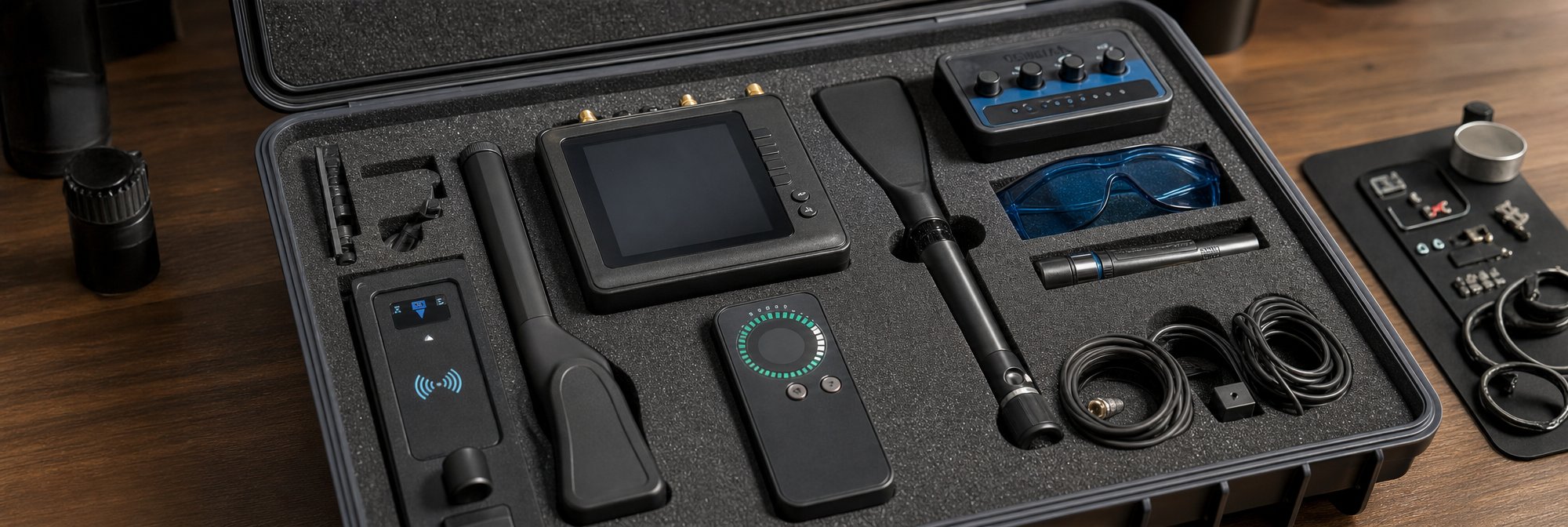
Effective RF work is based on repeatable patterns, controlled changes and observation over an appropriate period—not isolated alerts. For higher-risk inspections, specialist electronics detection can add useful evidence when combined with a mapped environment and careful physical follow-up.
Vehicles
A vehicle combines confined sight lines, noisy RF conditions, factory electronics and many potential mounting locations. Search logically: cabin accessories and charging devices first, then accessible trim, diagnostic-port area, luggage space, wheel-arch zones, underbody mounting points, battery area and external surfaces where safe to inspect. A hard-wired device may draw power from vehicle wiring; a magnetic tracker may be self-powered and mounted externally. Do not crawl beneath an unsupported vehicle or interfere with safety-critical wiring.
Movement testing can reveal behaviour that a parked scan misses, but physical inspection remains decisive for non-transmitting trackers. Record unusual items in place. If the vehicle is leased, company-owned, shared or subject to a legal dispute, obtain appropriate advice before removing anything, since location equipment may be authorised or its handling may affect evidence.
Reduce false positives with an evidence-based triage process
Counter-surveillance is vulnerable to two opposite errors: dismissing a genuine anomaly because it seems too ordinary, and treating every unfamiliar object as proof of targeting. A disciplined triage process avoids both. Score each finding against several questions: Is the object or alteration unexplained? Does it have a plausible collection function? Does it have power, storage, a cable route or a transmission path? Is its position useful? Can its behaviour be repeated? Is there a legitimate explanation supported by records or observation?
One weak indicator rarely justifies a conclusion. Several independent indicators deserve closer attention. For example, an unfamiliar adapter might be harmless. An unfamiliar adapter aimed at a conversation area, warm when unused, with an unexplained aperture and a repeatable local RF indication is a stronger case for escalation. Conversely, an RF alert near a documented router, with no visual anomaly and no change when the router is controlled, is likely ordinary infrastructure.
Keep notes neutral. Write what you observed rather than what you believe it proves: location, orientation, date, dimensions, serial markings, cables, power state, readings, photos and any controlled tests. Neutral documentation is more useful to a professional, property manager, lawyer or investigator than an emotionally certain narrative built on uncertain evidence.
What to do when you find a credible suspected device
First, prioritise personal safety. If there is an immediate threat, stalking concern, domestic-abuse context or reason to believe a person may react dangerously, leave the area and contact emergency services or a specialist support organisation as appropriate. Do not confront a suspected operator while alone, and do not undertake actions that increase risk.
In less urgent cases, avoid switching, charging, dismantling, resetting or removing the item unless safety requires it. Those actions can erase data, alter timestamps, break a cable route, destroy fingerprints or alert a remote operator. Photograph and video the item in context, including its position, surrounding area, power connection and any identifying marks. Record who found it, when, and what steps were taken. Limit access to the scene.
Then seek the correct escalation path: a qualified technical security professional for assessment, law enforcement where unlawful surveillance is suspected, legal counsel for workplace or dispute-sensitive matters, and the property owner or platform where appropriate. The detailed steps in this guide on responding after a hidden-device discovery explain how to protect evidence and rebuild security without accidentally undermining the investigation.
Build a repeatable inspection programme
The most effective counter-surveillance practice is not a one-time panic search. It is a proportionate routine. Establish an inventory of approved devices, record changes after maintenance or visitors, conduct quick visual checks before sensitive activity, review wireless and network baselines periodically, and schedule deeper inspections according to risk. Increase frequency after access-control failures, staff changes, travel, property handovers, disputes, unexplained technical anomalies or major changes to a sensitive room.
Maintain tools properly, but do not become tool-led. Test detectors against known, authorised sources so you understand their normal response. Keep batteries charged, read operating instructions, use controlled conditions where possible and document limitations. A poorly understood detector can create more confusion than reassurance. A basic, carefully executed physical inspection plus good records often provides more value than an expensive instrument used without a method.
For organisations and individuals building a capability over time, the counter-surveillance range provides a useful starting point for comparing categories of equipment. Select technology only after defining the threat, the environment, the permitted inspection scope, operator skill and the evidence or safety outcome required.
Final checklist: a defensible search for quiet devices
- Define the asset, threat, access opportunities and inspection boundary before opening a detector case.
- Document legitimate devices and normal room conditions to create a baseline.
- Search physically by zones, following sight lines, acoustic paths, power sources and cable routes.
- Inspect objects for plausible function, useful placement, modifications and unexplained apertures.
- Use optical checks for cameras that may record locally and never transmit.
- Observe RF activity under controlled changes and over an appropriate time window.
- Remember that no RF result is not proof that no device exists.
- Use specialist electronics-detection methods where risk and authority justify them.
- Record observations neutrally, repeat tests and separate facts from assumptions.
- Preserve a credible discovery in place and escalate through the appropriate professional or legal channel.
Passive, wired and dormant surveillance devices are difficult not because they are necessarily sophisticated, but because they exploit a predictable gap in casual searches: people look for a signal and stop when they do not find one. A better approach combines human judgement with technology. When you map the environment, follow power and access paths, inspect likely concealment points, test active emissions carefully and recognise the limits of every method, you turn an uncertain search into a structured counter-surveillance assessment.
A credible finding should be assessed through converging evidence, documented neutrally and preserved in place where safe. Regular, proportionate checks and clear escalation procedures are more dependable than a one-time tool-led search.
Frequently Asked Questions
Why can an RF scanner miss a hidden surveillance device?
An RF scanner detects radio energy, not every type of surveillance hardware. A camera may record to a memory card without WiFi, an audio recorder may store sound for later retrieval, and a wired microphone may send audio through a cable to equipment elsewhere. Devices can also be switched off, depleted, shielded, or configured to transmit only briefly.
Does a quiet RF detector prove that a room is free of bugs?
No. A quiet result only means that no sufficiently strong and relevant transmission was observed within the detector’s coverage range under those test conditions. It cannot rule out passive lenses, disconnected recorders, wired microphones, inactive trackers, or devices that transmit only at certain times or after a trigger.
What is the best way to search for dormant or non-transmitting surveillance devices?
Use a layered inspection rather than relying on one detector. Establish what equipment normally belongs in the space, inspect likely concealment and access points, observe RF activity over time, look for optical signs of cameras, trace power and cabling, and investigate anomalies that form a plausible pattern of concealment, power and collection capability.
What should I consider before starting a counter-surveillance inspection?
Start with a threat model. Define what needs protection, such as conversations, visual activity, travel patterns, documents or personal safety. Consider who could have had access, for how long, and whether they would need live information or could retrieve recordings later. Set clear boundaries that include relevant adjacent rooms, ceiling voids, utility areas, parking spaces or vehicle panels.
How does the suspected device type change the search method?
Live audio concerns call for RF observation, checks of power sources and network equipment, and review of acoustic access paths. Covert video concerns also require lens searches, sight-line reviews and reflection testing in a darkened room. Suspected vehicle tracking requires attention to mounting locations, wiring routes and movement-dependent behaviour rather than only a stationary RF scan.
Why is it important to create a baseline before looking for surveillance equipment?
Modern homes, offices and vehicles contain many legitimate wireless and electronic devices that can appear suspicious. List known equipment, routers, extenders, chargers, cables and installed cameras. Record the date, time, occupants, observed networks, existing damage and unusual objects. Comparing later inspections against this baseline makes meaningful changes easier to identify.
What physical signs can indicate a concealed surveillance device?
Useful indicators include mismatched finishes, fresh adhesive, disturbed dust, unexplained holes, recently painted patches, loose trim, unusual screws, duplicate objects, modified wall plates and cables with no identifiable purpose. An oddly placed object, warm adapter or unknown charger can also deserve attention. None of these signs proves surveillance alone; their relevance depends on the overall pattern.
Where should I look first during a physical bug sweep?
Inspect in a consistent sequence: entry points and sight lines, power and communications infrastructure, furnishings and decorative items, ceilings and walls, service voids, then adjacent or exterior access points. Start broadly and then examine closely. Consider whether each location offers a useful view, acoustic path, power source, cable route or a practical way to retrieve recorded material.
How can power-path analysis help find hidden electronics?
Even passive recording equipment needs energy unless it is unpowered. Identify outlets, USB supplies, extension leads, chargers, battery packs, lighting fixtures, smoke alarms, network switches and powered decorative objects. Check whether their placement, cable routing, heat and apparent function make sense. Compare wall plates and screws, and note cables entering voids without an obvious destination.
Should I open wall sockets, light fittings or other electrical installations during a search?
Do not open live electrical fittings, probe conductors or remove installed components unless you are qualified and authorised. Begin with visual checks instead: compare plates and screws, inspect cable routes and identify adapters that seem unusually large, permanently installed or connected to nothing visible. Shared electrical infrastructure may require records or professional inspection.
How can I identify a suspicious wired microphone or camera cable?
Wired devices often leave a physical route through a cable, conduit, ceiling penetration, duct, trunking channel, altered panel or connection box. Do not pull unknown wires. Document the visible route and check whether it matches legitimate security, audiovisual, fire alarm, access-control or network installations. Facilities records can help explain routes that initially appear unusual.
Can a hidden camera work without WiFi or a wireless signal?
Yes. A local-recording camera can store video internally on a memory card without transmitting through WiFi. This is why an optical lens search, review of viewing angles and inspection of objects facing beds, desks, entrances, safes or work surfaces are important. RF scanning alone cannot detect a passive camera lens or a camera that is not transmitting.
What should I check when I suspect a vehicle tracker?
Focus on physical mounting logic, wiring routes and behaviour linked to movement. A cellular tracker may remain silent while parked to conserve power and send a brief location report only after movement. Vehicle electronics such as telematics modules, tyre-pressure sensors, Bluetooth systems, keyless-entry components and factory antennas can also complicate interpretation of RF activity.
What should I do if I find a device that may be used for surveillance?
Preserve the original condition as far as possible, especially where evidence may matter. Photograph significant areas before moving items and document what was found, where it was located and visible connections or changes. In serious corporate, legal, personal-safety or criminal situations, avoid altering the suspected device and involve qualified counter-surveillance and legal professionals.