
- Why hidden microphones are difficult to detect
- Common types of hidden microphones and listening devices
- Wireless RF transmitters
- Cellular listening devices
- Wi-Fi audio devices
- Bluetooth-enabled microphones
- Standalone digital voice recorders
- Wired microphones
- Where hidden microphones are commonly concealed
- Early warning signs that justify a closer inspection
- Unexpected electronics or accessories
- Unexplained battery charging or power dependency
- Interference and unusual signal behavior
- Information leakage patterns
- How to search for hidden microphones step by step
- 1. Conduct a visual inspection first
- 2. Reduce environmental noise and wireless clutter
- 3. Use an RF detector realistically
- 4. Check for suspicious Bluetooth and Wi-Fi devices
- 5. Inspect likely power sources
- 6. Search soft concealment zones and furniture
- 7. Recheck after normal activity resumes
- Tools that can help, and their real limitations
- RF detectors
- Non-linear junction detectors
- Thermal cameras
- Flashlights and inspection mirrors
- Smartphone apps
- How hidden microphones differ from hidden cameras in detection
- Special considerations for offices and corporate environments
- Map legitimate devices first
- Pay attention to temporary access
- Protect high-value conversation zones
- Special considerations for vehicles
- What to do if you find a suspected listening device
- Do not over-handle the device
- Separate suspicion from confirmation
- Escalate appropriately
- Consider the broader security picture
- When to call a professional counter-surveillance specialist
- How to reduce the risk of hidden microphones going forward
- Control physical access
- Maintain a baseline inventory
- Use routine visual checks
- Be cautious with gifts and free accessories
- Train staff in practical awareness
- Conclusion
- Frequently asked questions
How to Detect Hidden Microphones: A Practical Counter-Surveillance Guide
Concerns about hidden microphones are no longer limited to high-risk corporate environments or sensitive investigations. Today, people worry about unauthorized audio recording in meeting rooms, executive offices, short-term rentals, private vehicles, home offices, and even personal living spaces. In many cases, the concern is legitimate: compact wireless transmitters, miniature digital voice recorders, and disguised listening devices are inexpensive, easy to conceal, and widely available.
At the same time, suspicion can quickly outpace reality. Not every unfamiliar object is a bug, and not every audio issue points to covert surveillance. A professional approach to detecting hidden microphones starts with methodical observation, basic technical checks, and a clear understanding of how modern listening devices actually work.
This guide explains practical ways to identify possible audio surveillance devices, what signs to look for, which tools are genuinely useful, and where limitations exist. It is written for readers who want a credible, structured overview rather than exaggerated claims. As always, any inspection or counter-surveillance activity should be carried out in compliance with applicable local laws, privacy rules, and property rights.
Why hidden microphones are difficult to detect
Modern spy microphones come in several forms. Some are live transmitters that send audio over radio frequency, cellular networks, Wi-Fi, or Bluetooth. Others are passive recorders that store audio internally and do not transmit anything at the time of use. This difference matters because the detection methods are not the same.
A simple RF detector may help identify some wireless transmissions, but it will not reliably reveal a standalone digital recorder that is only saving files to memory. Likewise, visual inspection may uncover crude concealment, yet a well-hidden wired microphone integrated into another system can be much harder to spot without technical assistance.
Another challenge is environmental noise. Offices, homes, hotels, and vehicles contain many legitimate electronics: routers, smart speakers, alarm systems, wireless keyboards, telematics modules, chargers, and IoT devices. These can create false positives during a sweep if the search is not carefully structured.
Common types of hidden microphones and listening devices
Before starting a search, it helps to understand what you may be looking for. The term hidden microphone covers multiple device categories with different behaviors, power needs, and concealment methods.
Wireless RF transmitters
These devices send captured audio using radio signals. They may operate continuously or use voice activation to conserve battery life. Depending on design, they can transmit over short or moderate range and may be hidden in clocks, power adapters, desk accessories, smoke detectors, or vehicle trim.
Cellular listening devices
A GSM bug or cellular audio device uses a SIM card or similar communication module to relay audio through mobile networks. Some can answer an incoming call silently, while others upload audio clips or stream on demand. These devices may be more difficult to distinguish from ordinary electronics because they do not always transmit continuously.
Wi-Fi audio devices
Some modern covert microphones connect to a local network and can be accessed remotely through an app or cloud service. They may appear as unidentified devices on a router, but a network scan alone is rarely enough to confirm malicious intent.
Bluetooth-enabled microphones
Bluetooth can be used for short-range listening or setup. A suspicious nearby Bluetooth device may deserve attention, though many harmless devices also use the same protocol.
Standalone digital voice recorders
These are among the most overlooked threats because they may not emit any useful signal during recording. Detection often depends on visual inspection, acoustic clues, power-source analysis, and physical examination of likely hiding places.
Wired microphones
A wired microphone may feed into another recording or transmission system. In fixed environments, this can involve modified wall plates, cable runs, furniture, or communication systems. These setups typically require a more technical inspection.
Where hidden microphones are commonly concealed
Concealment follows practicality. A microphone must be close enough to capture intelligible speech, yet hidden well enough to avoid casual notice. In professional sweeps, examiners focus on spots that offer good acoustics, power access, and plausible camouflage.
- Meeting rooms: conference phones, power strips, decorative objects, wall clocks, presentation equipment, light fixtures
- Offices: desk organizers, chargers, computer accessories, smoke detectors, picture frames, plant pots
- Homes and rentals: alarm clocks, smart devices, USB chargers, TV boxes, lamps, air purifiers
- Vehicles: dashboard seams, under seats, headliners, center consoles, OBD-related areas, trim panels
- Temporary spaces: hotel rooms, serviced apartments, event venues, interview rooms
If a suspected device is intended to capture conversation, it will usually be placed where people naturally speak: seating areas, bedside zones, desks, conference tables, or driver and passenger compartments.
Early warning signs that justify a closer inspection
Not every concern means surveillance is present, but some indicators deserve a careful review. A bug sweep becomes more reasonable when unusual signs appear in combination rather than isolation.
Unexpected electronics or accessories
An unfamiliar charger, adapter, alarm clock, smoke detector, or USB hub in a room that you know well should be checked. In rental spaces or hotel rooms, look for devices that seem oddly placed, newly installed, or unnecessarily directed toward conversation areas.
Unexplained battery charging or power dependency
Covert microphones need power. If an object seems heavier than expected, warms slightly without clear reason, or remains plugged in constantly despite no apparent function, it may justify closer attention.
Interference and unusual signal behavior
Some wireless microphones can generate RF activity or interfere with nearby electronics, although this is not a reliable standalone indicator. Repeated unexplained device appearance in RF scans near private discussions can be more meaningful.
Information leakage patterns
If confidential conversations repeatedly become known to outside parties despite controlled access, unauthorized audio capture is one possibility among several. Data leaks, human error, compromised accounts, and visual observation should also be considered.
How to search for hidden microphones step by step
A structured search is far more effective than randomly waving a detector around a room. Start with the simplest and most reliable methods before moving to more specialized tools.
1. Conduct a visual inspection first
The foundation of counter-surveillance is observation. Begin by documenting the environment. In a known space, compare current conditions to what should normally be present. In an unfamiliar space, assess whether devices make sense for the room’s function.
Focus on:
- Objects pointed toward conversation areas
- Items with tiny openings that could hide a microphone port
- Recently added adapters, chargers, or cable junctions
- Duplicate or unnecessary devices, such as two clocks or multiple detectors in one small area
- Loose trim, non-matching screws, adhesive residue, or signs of tampering
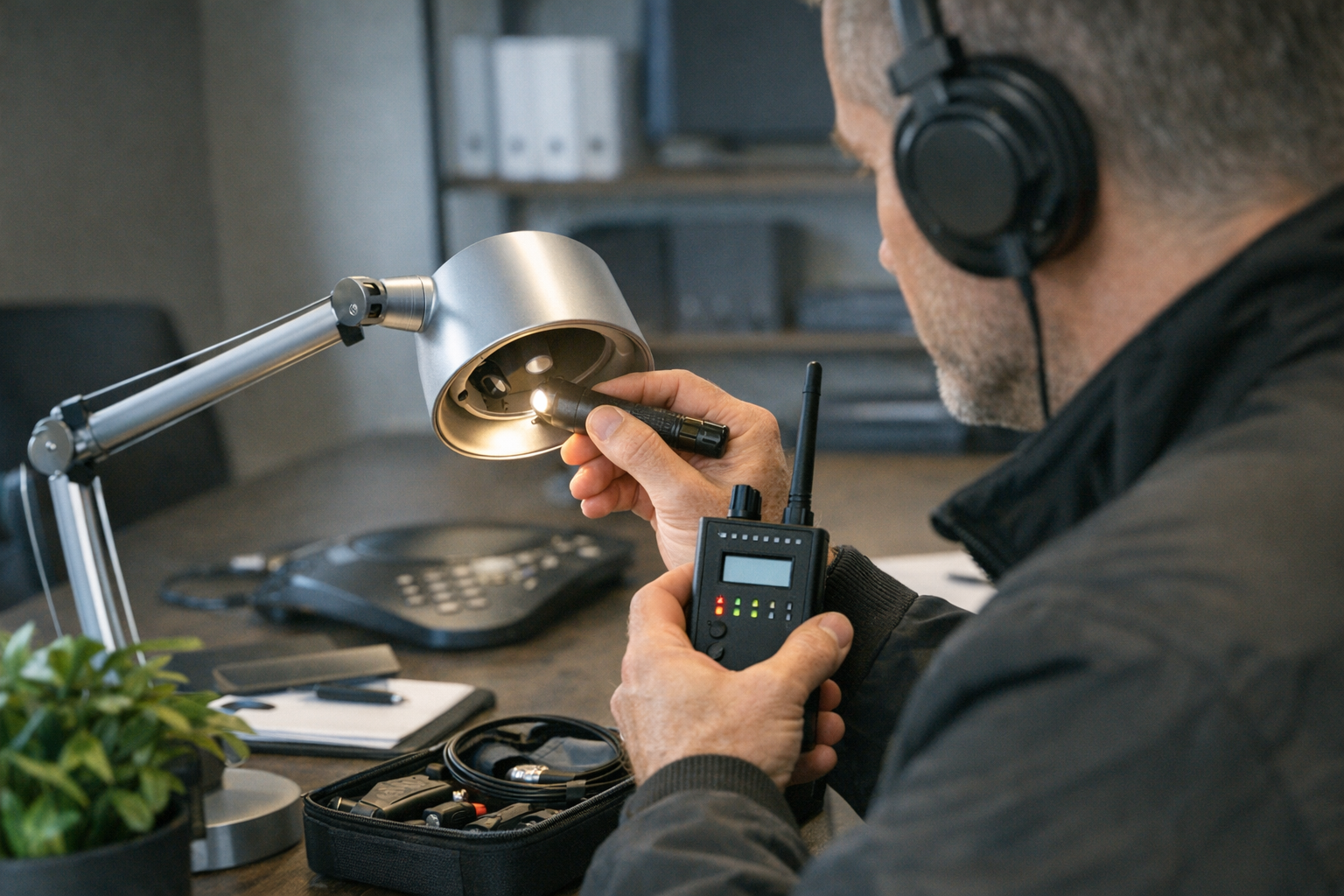
A bright flashlight helps reveal pinholes, mesh openings, and modified casings. In quiet conditions, you may also hear faint electronic hums, relay clicks, or vibration from cheap equipment.
2. Reduce environmental noise and wireless clutter
Before using electronic detection tools, switch off or temporarily unplug as many legitimate devices as practical and lawful. This may include speakers, smart assistants, wireless accessories, routers in controlled testing conditions, and chargers. The cleaner the environment, the easier it becomes to identify suspicious signals or unexplained power sources.
In offices or corporate environments, coordinate this process carefully so that security, IT, and safety systems are not disrupted unintentionally.
3. Use an RF detector realistically
An RF detector for hidden microphones can be useful, but expectations should remain realistic. These tools measure radio activity, not malicious intent. They can help identify active transmitters, but they cannot confirm that every detected signal is a bug.
When using one:
- Move slowly and methodically
- Scan close to objects, not just the center of the room
- Test at different times, since some devices transmit intermittently
- Compare results with known electronics turned on and off
- Watch for signal spikes tied to specific objects rather than broad ambient activity
A strong response near a common electronic product may still be normal. The result becomes more meaningful when the object has no clear communication function or when the signal persists under suspicious conditions.
4. Check for suspicious Bluetooth and Wi-Fi devices
Basic network awareness can help identify anomalies. Scan for nearby Bluetooth names and review connected or recently seen devices on a router you control. Unknown devices do not automatically equal surveillance, but they can provide leads.
Useful questions include:
- Does the device appear only in one sensitive room?
- Is it active at odd times?
- Does it have a generic or obscure identifier?
- Can it be associated with a legitimate employee, resident, or approved system?
Be cautious here. Many consumer electronics use random identifiers, and some hidden devices do not remain continuously discoverable.
5. Inspect likely power sources
Because covert listening devices need electricity, power analysis is often more revealing than signal hunting. Examine wall adapters, USB chargers, extension blocks, battery packs, and any object with an unexplained cable route. Devices hidden inside power accessories are common because they blend into the background and can operate for long periods.
If you are legally authorized and technically competent to do so, compare the visible function of an item with its actual internal design. If not, preserve the item and involve a qualified professional.
6. Search soft concealment zones and furniture
Standalone recorders are often hidden in practical, low-tech places: under cushions, inside desk drawers, behind books, taped beneath tables, under vehicle seats, or within storage compartments. Physical inspection matters because non-transmitting devices may leave little or no electronic signature.
7. Recheck after normal activity resumes
Some microphones are voice activated or only connect periodically. If an initial sweep is inconclusive, repeat checks during realistic conditions. For example, conduct another RF and network review during a meeting period or after occupancy returns to normal.
Tools that can help, and their real limitations
The market for counter-surveillance equipment includes many products with exaggerated claims. The best approach is to understand what each tool can and cannot do.
RF detectors
Useful for identifying some wireless transmitters, especially if they are currently active. Less useful for passive recorders, dormant devices, or environments saturated with legitimate signals.
Non-linear junction detectors
Professional-grade tools can help identify electronic components even if the device is not transmitting. They are valuable in advanced sweeps but require skill, budget, and proper interpretation. They are generally beyond casual consumer use.
Thermal cameras
A powered device may produce a heat signature, but this method is situational. Many normal electronics also generate heat, and battery-powered bugs may not produce obvious results.
Flashlights and inspection mirrors
Simple but effective. Many hidden devices are found through patient physical inspection rather than expensive instruments.
Smartphone apps
Apps that claim to detect all bugs are often oversold. Some may help with Wi-Fi or Bluetooth visibility, magnetic field awareness, or camera lens reflection in limited contexts, but they should not be treated as professional detection solutions.
How hidden microphones differ from hidden cameras in detection
People often search for microphones using methods designed for cameras. That can create confusion. A camera may reveal itself through a lens reflection, unusual viewing angle, or video transmission pattern. A hidden listening device is often smaller, easier to disguise, and may need only a tiny sound port or no visible opening at all depending on the object.
This is why acoustic placement, power analysis, and physical object legitimacy are so important. If your concern is audio surveillance specifically, your inspection must focus on where sound is best captured, not just where a lens would have a useful line of sight.
Special considerations for offices and corporate environments
In business settings, unauthorized audio capture raises confidentiality, trade secret, HR, and reputational concerns. However, an office is also full of approved electronics that can complicate detection.
Map legitimate devices first
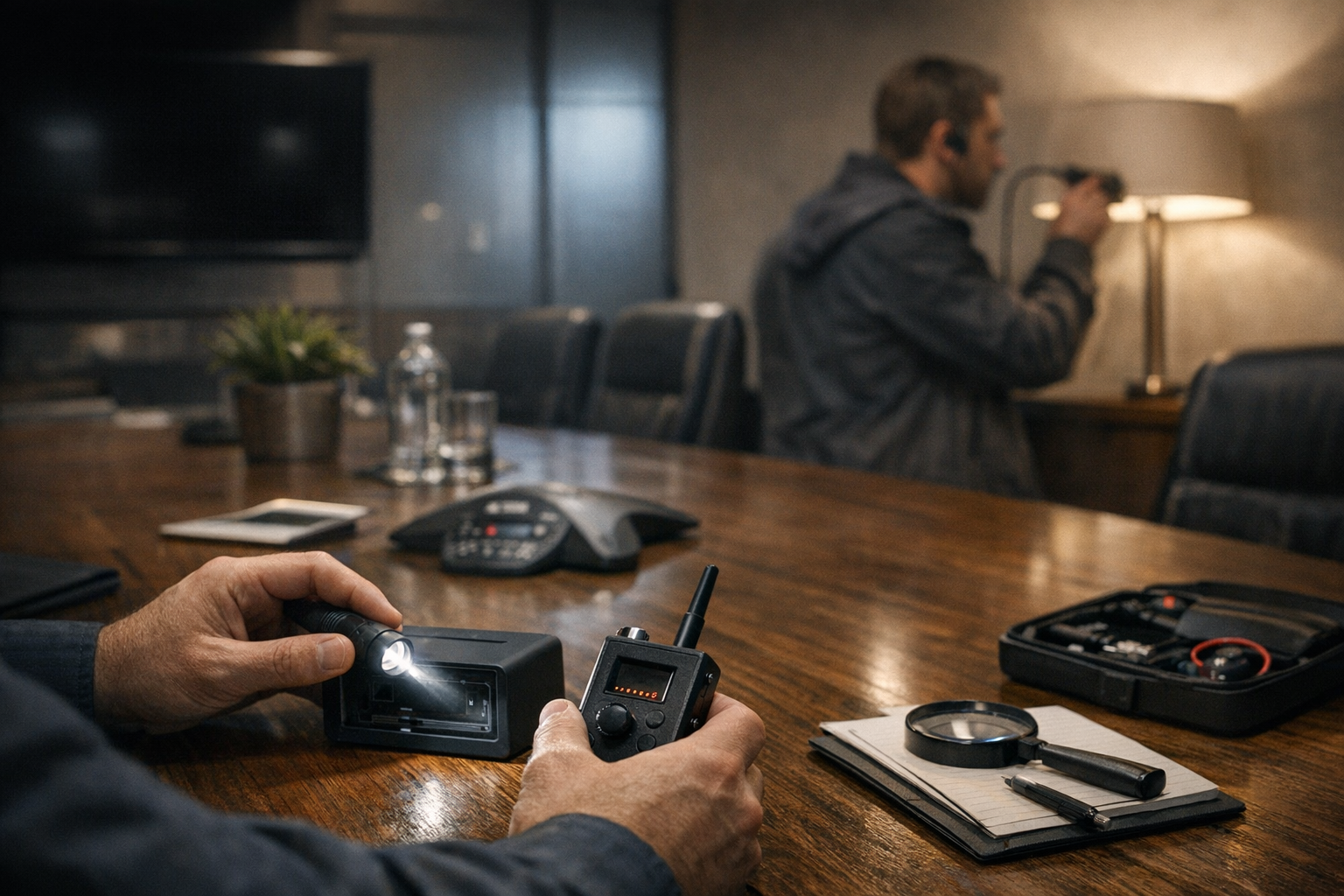
Create an inventory of conference systems, VoIP hardware, smart displays, occupancy sensors, access control components, and approved wireless equipment. This baseline reduces confusion during a technical surveillance counter-measures process.
Pay attention to temporary access
Contractors, maintenance providers, cleaning teams, event vendors, and short-term visitors may all have opportunities to place a device. Review not just permanent installations, but also temporary objects left behind after meetings, repairs, or events.
Protect high-value conversation zones
Boardrooms, legal offices, executive meeting spaces, prototype labs, and interview rooms deserve more disciplined inspection routines. In higher-risk cases, periodic professional sweeps may be justified.
Special considerations for vehicles
A hidden microphone in a car can be especially intrusive because vehicle cabins are enclosed, speech is close-range, and people often discuss personal or business matters while driving. Cars also contain many legitimate electronics, including hands-free systems, telematics modules, navigation hardware, parking sensors, dash cams, and charging accessories.
Start with basic checks:
- Look for new accessories in 12V outlets or USB ports
- Inspect under seats, seat-back pockets, center consoles, and glove compartments
- Check trim areas that seem recently disturbed
- Review aftermarket devices installed by unknown parties
If you suspect a more integrated installation, professional examination is advisable because modern vehicles are electronically complex and easy to damage through improper disassembly.
What to do if you find a suspected listening device
Discovery is only one part of the response. What you do next matters. If you immediately destroy or tamper with the object, you may complicate any legal, corporate, or investigative follow-up.
Do not over-handle the device
If safe to do so, minimize contact. Photograph the item in place, note the date, time, and exact location, and preserve surrounding context such as cables, adapters, or concealment method.
Separate suspicion from confirmation
Many objects look unusual without being surveillance equipment. A careful assessment by qualified personnel can prevent false accusations and preserve credibility.
Escalate appropriately
Depending on context, that may mean internal security, legal counsel, property management, IT security, or law enforcement. The correct path depends on your location, the environment, and who controls the premises.
Consider the broader security picture
A hidden microphone may be an isolated issue, or part of a wider compromise involving physical access, insider threats, or cyber intrusion. Review access logs, visitor history, key control, and relevant digital security indicators.
When to call a professional counter-surveillance specialist
There is a practical limit to what a self-guided search can achieve. If the risk is high, the environment is sensitive, or repeated concerns remain unresolved, a qualified specialist may be the right step.
Professional services are particularly relevant when:
- Confidential business, legal, political, or investigative discussions are involved
- You suspect a sophisticated or integrated installation
- The location contains extensive electronics and RF noise
- Evidence preservation is important
- Previous information leaks suggest an ongoing compromise
A credible provider should explain methods clearly, avoid unrealistic guarantees, and define the scope of the inspection. No ethical professional should promise that every threat can always be found under all conditions.
How to reduce the risk of hidden microphones going forward
Prevention is often easier than detection after the fact. Sensible security habits can reduce exposure significantly.
Control physical access
Limit unsupervised access to sensitive rooms, vehicles, and equipment. Temporary access is often the easiest route for device placement.
Maintain a baseline inventory
Know what belongs in a room. Photos and equipment logs make it easier to spot additions or modifications.
Use routine visual checks
Regular low-tech inspections catch many unsophisticated attempts. This is particularly helpful in meeting spaces, executive offices, and serviced accommodations.
Be cautious with gifts and free accessories
Promotional electronics, charging devices, desk gadgets, and unexplained accessories should not enter sensitive areas without review.
Train staff in practical awareness
Employees do not need to become technical experts, but they should know how to report unfamiliar objects, suspicious installations, and repeated information leakage concerns.
Conclusion
Detecting hidden microphones requires patience, realism, and a methodical process. The most effective approach combines visual inspection, environmental understanding, selective use of RF and network tools, and attention to likely power sources and concealment points. While consumer tools can help in some situations, they are not magic solutions, especially against passive recorders or well-integrated devices.
For homes, offices, rentals, and vehicles alike, the goal is not panic but informed vigilance. If something seems out of place, document it, inspect it carefully, and escalate appropriately when the stakes are high. And because surveillance laws, privacy expectations, and evidence-handling rules vary by jurisdiction, always ensure that any search or response is conducted within applicable legal and regulatory boundaries.
In short, a credible counter-surveillance mindset is built on observation, verification, and restraint. That is what turns suspicion into actionable clarity.
Frequently asked questions



Comments (0)
Post a comment