
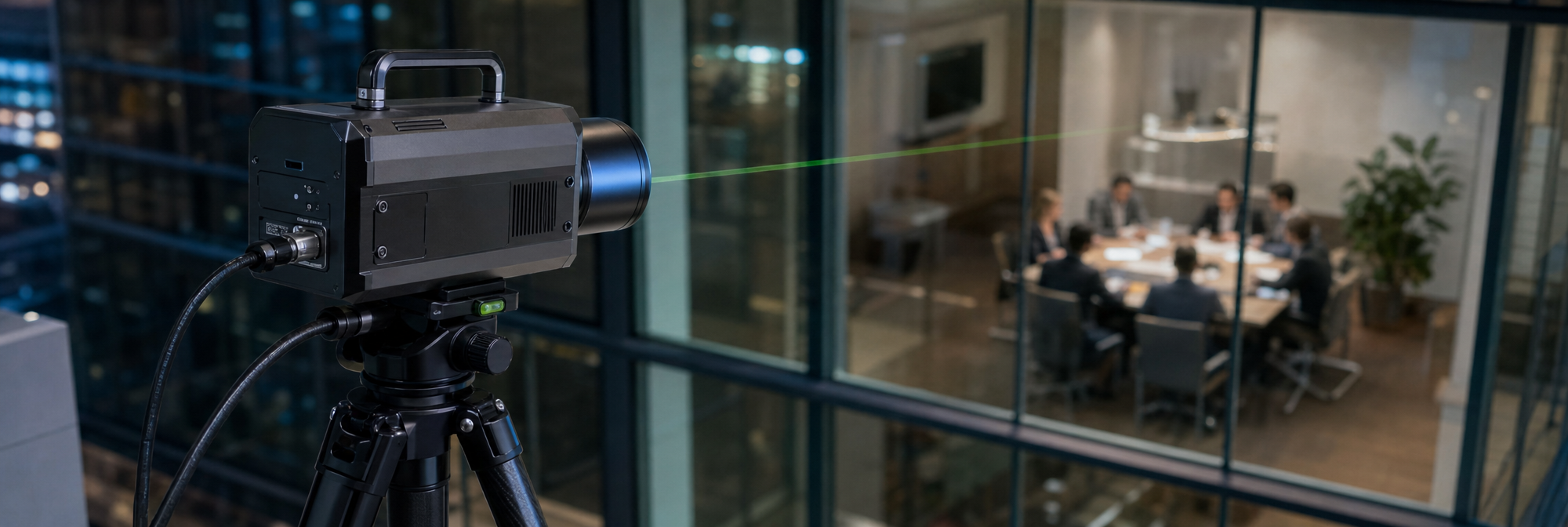
Audio collection is often discussed as if every requirement could be solved by placing a small microphone closer to a source. In professional work, that is not always the right operational model. There are authorised situations in which access to the listening area is restricted, the subject cannot be approached, and the real question is whether sound can be worked with from a remote position rather than from inside the space.
That is the context for our 2 in 1 laser microphone professional passive active long ran. It is a professional, long-range laser-microphone format built around two operating approaches: passive and active. It should be selected as a specialist instrument for a clearly defined, lawful assignment—not as a substitute for every voice recorder, connected microphone or close-proximity audio device.
The key distinction is practical: this product belongs to a remote, line-of-sight audio workflow. That makes it relevant where the position of the operator, the available observation point and the surface being worked with are central to the plan. It is a more deliberate choice than a conventional microphone placed within the room, and that is precisely its value when an authorised operation calls for distance.
Why the 2-in-1 passive/active format matters
“2 in 1” is not a cosmetic label. On a professional laser microphone, combining passive and active modes gives the operator two distinct working modes in one specialist format. This makes the product relevant to assignments that demand flexibility at the capture stage rather than a single fixed approach.
In product selection, we treat this as a capability with a purpose. A buyer looking only for straightforward local audio capture does not necessarily need a professional passive/active laser microphone. By contrast, an authorised user designing a remote listening position can benefit from a tool whose identity is built around laser operation, long-range use and two modes of work.
The result is a more focused equipment decision. Rather than assembling a deployment around an in-room microphone and then trying to compensate for the lack of access, the operator starts with the operating constraint: capture at distance. The 2-in-1 professional laser microphone addresses that constraint directly.
A laser microphone is chosen for the position, not for concealment
There are many ways to collect audio lawfully, and each solves a different problem. A concealed microphone is selected when the authorised deployment requires a compact format within the relevant environment. A voice recorder is selected when local recording and physical proximity suit the task. A GSM or Wi-Fi microphone is part of a different workflow again, centred on connected access.
The professional laser microphone is different. It is selected because the operator can work from a remote point and because the operational design supports a line-of-sight approach. It is therefore not a general-purpose answer to every requirement for discreet sound capture. It is a dedicated answer to the narrow but important question of how to conduct an authorised long-range audio operation without placing the listening device in the target area.
This distinction prevents poor equipment choices. Buying a long-range laser format for a job that requires local, unattended recording creates unnecessary complexity. Equally, relying on a basic close-range microphone where the working distance is the defining constraint leaves the operation poorly matched to the environment. The right device is the one that follows the authorised scenario, not the one with the broadest-looking product name.
Our wider spy microphone range reflects these differences in operating model. The point is not to treat the category as interchangeable. It is to identify whether the assignment needs local capture, recording, connectivity, contact-based collection, directional pickup or a professional laser-microphone approach.
Where this professional format has a clear role
The 2 in 1 laser microphone professional passive active long ran is relevant to authorised professional applications where working distance is a fundamental requirement. That can include controlled investigative work, security assessments undertaken with permission, and technical audio observation carried out within the legal authority applicable to the operator and location.
Its usefulness begins before the equipment is even unpacked. The operator can plan around an external position, assess the available sightline, establish stable working conditions and decide whether the job genuinely calls for passive or active operation. This is a considered workflow, not an improvised add-on to a general monitoring task.
The device is especially coherent when the observation point is separate from the area where sound originates. In those circumstances, the benefit is not merely “more distance.” It is the ability to structure the authorised audio-capture process from a remote position, while keeping the equipment choice aligned with the physical realities of the site.
Operational discipline remains part of audio quality
A professional long-range format rewards careful preparation. Sightline, stability at the operator’s position, the chosen working surface and the surrounding acoustic environment all shape whether a remote audio task is viable. These are not minor deployment details; they are the core conditions that distinguish a laser-microphone assignment from a conventional microphone placement.
For this reason, we recommend beginning with a site-based question: does the authorised task provide a usable remote position with a direct, controllable line of sight? If it does, a professional laser microphone becomes a credible category to assess. If the task instead depends on capturing speech inside a controlled room, a more conventional audio format will often be the more proportionate choice.
Passive and active operation: selecting the mode around the assignment
The passive/active design is the defining selection point of this 2-in-1 product. It gives professional users a choice of operating mode within the same laser-microphone platform. That flexibility is valuable because a long-range audio assignment should be planned around the actual environment, not forced into one method by a single-mode device.
It is important to make the distinction at the planning stage. Establish the lawful scope of the task, define the listening objective, choose the permitted observation position and assess the practical conditions there. Only then should the operator decide which working mode supports that plan. This sequence keeps the equipment in service of the mission rather than allowing the equipment to dictate the mission.
For teams that conduct varied authorised work, the two-in-one format also has a straightforward organisational advantage: it concentrates passive and active capability in one professional product category. That is a more coherent proposition than treating every new assignment as a reason to acquire an entirely separate long-range platform.
How it compares with other specialist microphone categories
The laser format should be compared with adjacent categories on the basis of deployment geometry, not marketing labels.
- Versus a concealed microphone: a concealed format is designed for placement within an environment. The 2-in-1 laser microphone is designed for a remote, line-of-sight workflow.
- Versus a voice recorder: a recorder is appropriate when it can lawfully be placed close enough to capture the required audio locally. The laser format addresses a different problem: authorised capture from a separate position.
- Versus a wall microphone: contact-oriented work has its own physical requirements. A laser microphone is selected where the remote optical approach suits the site and task.
- Versus a parabolic microphone: both categories can be considered for distance-based work, but they are distinct capture formats. The passive/active laser approach should be evaluated on its own operating conditions rather than treated as a generic directional-audio alternative.
For a wider view of directional options, our parabolic microphone category provides a useful comparison point. It underlines why “long range” is not, by itself, a complete selection criterion. The intended working position and the capture method matter just as much.
Selection checklist before choosing this product
We recommend the 2 in 1 laser microphone professional passive active long ran when the following conditions define the assignment:
- The operation is authorised and lawful. Audio work must be planned within the applicable rules, permissions and professional remit.
- Distance is the actual constraint. The requirement is not simply discreet audio; it is the ability to work from a remote position.
- A line-of-sight workflow is available. The operator can plan from a suitable observation point rather than relying on access inside the relevant area.
- Passive and active modes add operational value. The assignment benefits from the flexibility of a 2-in-1 professional format.
- The task justifies specialist equipment. This is a dedicated laser microphone for a specific class of audio work, not a universal replacement for standard microphones.
That checklist helps preserve the product’s real advantage. The strongest reason to choose it is not that it can be described as advanced; it is that its laser, professional, passive/active and long-range identity fits a defined operational requirement.
Installation and working practice: make the observation position do its job
With a professional long-range audio device, deployment starts at the observation position. A stable, safe and authorised operator location is the foundation of the workflow. From there, the task is to establish and maintain a controlled line of sight consistent with the planned mode of operation.
Build the deployment around clear objectives. Decide what authorised audio outcome is required, define the working period, avoid unnecessary changes in position and document the operational context according to the procedures governing the assignment. This makes the work more repeatable and keeps the specialist equipment focused on its intended role.
It is also sensible to separate audio collection from unrelated surveillance requirements. When a deployment needs visual coverage as well as sound, choose the visual element according to its own placement, coverage and governance needs. Our spy camera range supports that separate decision process. A camera and a laser microphone may form part of the same authorised operation, but they should not be selected as if they solve the same technical problem.
A focused professional tool, not a generic audio shortcut
The 2 in 1 laser microphone professional passive active long ran earns its place where an authorised audio operation has a genuine long-range requirement and a workable line-of-sight setup. Its professional laser format, combined passive and active operation, and long-range purpose make it a specialist choice for users who need to plan around distance rather than around device placement in the listening area.
That specificity is the product’s strength. It is not competing with every compact recorder or connected microphone. It addresses a more exact operational need: structured, remote audio work where the observation position matters as much as the microphone itself. For professional users whose assignments meet that profile, it is the right category to consider first.
For selection context across the range, our laser microphone category brings together the professional products intended for this distinct long-range audio discipline.
Frequently Asked Questions
What is a 2-in-1 passive/active laser microphone designed for?
A 2-in-1 passive/active laser microphone is a specialist professional format for authorised long-range audio work. It is intended for situations where the operator must work from a remote position rather than placing a microphone inside the listening area. Its purpose is not to replace standard microphones, recorders, or connected devices for ordinary local audio capture.
Why does the product combine passive and active modes?
The combined passive and active design gives professional users two operating modes within one laser-microphone platform. This can be useful when an authorised assignment requires flexibility at the capture stage. The appropriate mode should be selected only after defining the lawful scope, listening objective, permitted observation position, and practical conditions of the site.
When is a laser microphone an appropriate category to consider?
A professional laser microphone is appropriate to assess when distance is the defining constraint, a usable remote observation position exists, and a direct, controllable line of sight is available. It is intended for authorised work where the sound source is in a separate area and placing a listening device within that area is not the operational model.
Is a laser microphone a general-purpose solution for discreet audio capture?
No. This format is not presented as a universal solution for discreet audio capture or as a replacement for every recorder, microphone, or connected audio device. It is a dedicated tool for a narrow operational requirement: authorised remote audio work based on a line-of-sight approach and a workable observation position.
How does a laser microphone differ from a concealed microphone?
A concealed microphone is selected when an authorised deployment requires a compact device placed within the relevant environment. A professional laser microphone follows a different model: it is selected for remote, line-of-sight work from an external observation position. The choice depends on the authorised scenario and the physical access available at the site.
How does this product compare with a voice recorder?
A voice recorder is suited to tasks where it can lawfully be placed close enough to collect the required audio locally. The passive/active laser format addresses a different situation: authorised capture from a separate position. Choosing between them depends on whether proximity or working distance is the fundamental operational constraint.
What site conditions affect the viability of remote laser-microphone work?
The key conditions include a direct and controllable sightline, stability at the operator’s position, the chosen working surface, and the surrounding acoustic environment. These factors shape whether a remote audio task is viable. A site assessment should begin by determining whether the authorised task provides a suitable remote position with usable line of sight.
Why is the observation position important for this type of audio work?
The observation position is the foundation of the workflow because the device is designed around remote operation. It should be stable, safe, authorised, and capable of supporting a controlled line of sight. Deployment should be planned from that position, with clear objectives, a defined working period, and minimal unnecessary changes in location.
What authorised applications can this professional laser format support?
The article identifies controlled investigative work, permission-based security assessments, and technical audio observation as examples of authorised professional applications. In every case, the operator must work within the legal authority applicable to the person and location. The equipment should serve a defined lawful assignment rather than an improvised general monitoring task.
How does a laser microphone differ from a wall microphone?
A wall microphone is associated with contact-oriented work and its own physical requirements. A laser microphone is considered when a remote optical approach fits the site and the task. They should not be treated as interchangeable simply because both may be used in specialist audio work; their deployment conditions and capture methods differ.
How does the laser format compare with a parabolic microphone?
Both laser and parabolic microphones may be considered for distance-based work, but they are distinct capture formats. “Long range” alone is not enough to choose between them. The intended working position, capture method, site conditions, and authorised operational requirements should determine which category is more appropriate for the assignment.
What should be checked before selecting a 2-in-1 passive/active laser microphone?
Confirm that the operation is authorised and lawful, that distance is the real constraint, and that a suitable line-of-sight workflow is available. Also assess whether passive and active modes provide meaningful value for the assignment and whether the task genuinely justifies specialist equipment. It is intended for defined long-range work, not as a universal audio shortcut.



Comments (0)
Post a comment