
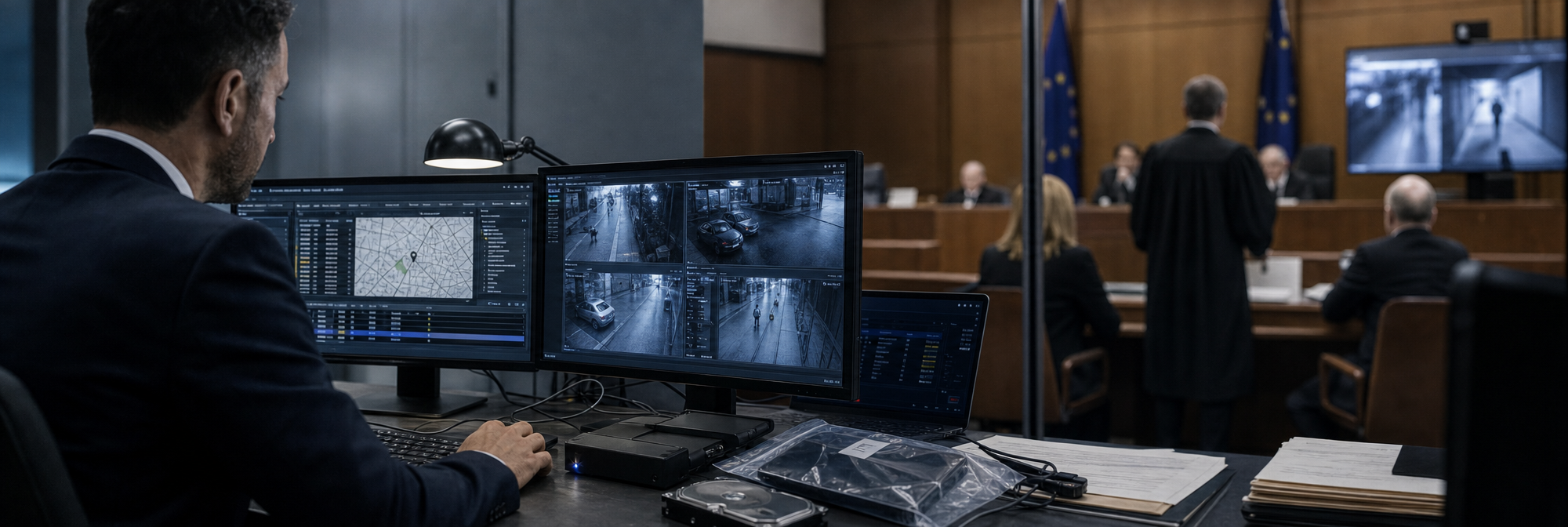
Published 22 October 2026. A camera recording, an access-control event, a vehicle location history or an alarm notification may begin life as a security signal. After an incident, however, it can become something more consequential: a piece of digital evidence whose value depends on far more than whether it was captured.
That is the practical message behind Europol’s 16 October 2026 announcement of its Digital forensics: gap analysis, produced with the European Commission. The report examines weaknesses in the EU’s capacity to recover, analyse and present digital evidence as investigations increasingly involve cloud services, Internet of Things (IoT) devices, connected vehicles and AI-assisted processes.
For the connected-security sector, the news is not that every camera, alarm or tracker is suddenly subject to a new private-sector evidential regime. It is not. The report addresses law-enforcement capabilities, while admissibility remains dependent on the applicable legal framework and the facts of an individual case. But it does clarify a direction of travel: security data is increasingly expected to survive a transition from operational alert to credible record.
That transition is where many deployments become fragile. A clip may exist but have an uncertain timestamp. A device may report an event but provide no useful administrator log. Data may be retained in a provider cloud in another country, exported in a difficult proprietary format, or overwritten before anyone realises it matters. More collection does not resolve any of those problems.
The October 2026 warning: evidence is now distributed
The Commission says the gap analysis focuses on tool standardisation, cloud forensics, IoT and vehicle forensics, AI in forensics, and training gaps affecting first responders and legal professionals. It follows the Commission’s June 2025 Roadmap for lawful and effective access to data, which called for an assessment of common or shared technical digital-forensics solutions.
The report’s relevance becomes immediately clear in the devices it identifies: smart-home systems, industrial sensors, drones, connected cars and other IoT equipment. These are not neat, standalone evidence containers. Their records may be split between a device, a mobile application, a local gateway, a customer account, a manufacturer platform and a cloud provider. Some lack practical forensic interfaces altogether.
Security installations increasingly share that architecture. A modern video surveillance system may combine edge recording, remote live access, motion events, user permissions and cloud backup. An intrusion alarm may generate sensor events, notifications and panel logs. A GPS tracker can produce a timeline that is meaningful only when its location records, time source, configuration and account access history can be understood together.
In other words, the item seen on a dashboard is often only the visible end of a wider data chain. The central question is no longer simply, “Did the system detect something?” It is, “Can the relevant record be retrieved, preserved, interpreted and accounted for later?”
Why a useful video clip can still be weak evidence
In everyday security operations, the instinct after an incident is understandable: find the footage quickly. Yet speed alone is not a complete evidence process. A clip’s later usefulness can be affected by when it was exported, by whom, from which account, with what settings and whether the original material remains available for verification.
Europol specifically notes the complications surrounding home-security cameras whose recorded events are held on providers’ servers, potentially in another country. Acquisition can be delayed, difficult or impossible. The same logic applies more broadly to cloud-dependent security environments: convenience and remote access do not automatically guarantee recoverability at the moment it matters.
Retention is an operational decision with evidential consequences
A seven-day retention setting may look adequate until a weekend, a holiday period, a delayed report or a cross-border request consumes the available time. Conversely, extending retention without a clear purpose can create unnecessary privacy, cost and governance burdens. Forensic readiness is not an argument for retaining everything indefinitely. It is an argument for making a deliberate, documented retention decision that matches the risks, lawful basis and incident-response reality of a site.
Where local recording is part of the workflow, resilient memory storage and a documented procedure for removing, replacing and securing media matter. Where the workflow depends on remote services, responsible teams should understand the provider’s retention rules, account controls and export process before an incident—not discover them under pressure.
Timestamps are not a small technical detail
Video, access logs, alarm events and location histories are often correlated to reconstruct sequence: who arrived first, when a door opened, whether an alert preceded a loss of connectivity, or whether a vehicle was at a specified place. Poor clock configuration can undermine that reconstruction even when the underlying image or event is genuine.
Time synchronisation should therefore be treated as an ongoing maintenance item. So should documentation of time zones, daylight-saving behaviour and any known offset between systems. It is mundane work, but incidents are often decided by mundane details.
Interoperability has moved from convenience to resilience
Europol identifies proprietary formats and fragmented validation practices as barriers to analysis, cooperation and evidence reuse. This is a significant observation for buyers and system designers. A platform that works smoothly while everything is normal may still create friction when records need to be moved, reviewed independently or combined with other sources.
Procurement conversations often prioritise image quality, detection range, remote access and integration on a daily basis. Those remain important. But a connected-security specification should also ask more uncomfortable questions:
- Can video, logs and event histories be exported in a documented and intelligible way?
- Does an export preserve relevant metadata, rather than delivering only a stripped-down clip or screenshot?
- Can a reviewer identify the system, user account, settings and time basis associated with a record?
- What happens if the supplier’s cloud service, mobile app or subscription is unavailable?
- Who is authorised to alter retention, user permissions or device configuration, and is that action logged?
These are not demands for every buyer to become a forensic laboratory. They are resilience questions. An installer or integrator does not determine a court’s assessment of evidence, but configuration and documentation choices can strongly influence whether reliable records are still available to the people who need them.
The point is equally relevant to a surveillance drone workflow, where media, flight information and controller data can be separate records, and to connected vehicles, where location, onboard events and cloud-account information may sit across different systems. One incident can require several timelines, not one file.
Chain of custody starts before the incident
“Chain of custody” can sound like language reserved for investigators and courtrooms. In practice, the foundations are often laid much earlier by ordinary security administration: assigning named accounts instead of shared credentials; limiting privileged access; recording administrator actions; maintaining a configuration baseline; and knowing who may export or delete data.
Forensic readiness does not mean turning every security team into law enforcement. It means recognising that system data has a lifecycle. A practical pre-incident approach may include:
- maintaining an asset list that identifies cameras, sensors, recorders, gateways and associated cloud accounts;
- checking that system clocks and time sources are consistent;
- documenting retention periods, overwrite behaviour and the steps for preserving a relevant record;
- using role-based accounts where feasible, with reviewable access and administrative histories;
- recording firmware, software and configuration changes that could affect interpretation of a record; and
- keeping a proportionate incident log that records who handled material and what action was taken.
Encryption belongs in this picture with proper nuance. It protects confidentiality and integrity, particularly for sensitive security information. But if encryption keys, access responsibilities and recovery processes are unclear, lawful acquisition and later review can become difficult. The objective is not weaker protection; it is controlled, documented protection. Security teams considering an encrypted device should assess governance around access and recovery alongside the security benefit itself.
AI analytics should produce leads—not unexplained conclusions
AI is now routinely discussed in video analytics, anomaly detection, object classification and recognition workflows. Europol’s report does not make the simplistic claim that AI is unusable. Its concern is defensibility: AI-assisted outputs must be transparent, logged, documented, reproducible and manually verifiable where necessary. Black-box outputs can create problems for chain of custody and admissibility.
For security operators, this means preserving a distinction between the original material and the system’s interpretation of it. An analytic alert may help an operator find a relevant moment in hours of footage. That can be valuable. But the alert should not silently replace the original video, the underlying log or human review.
A well-governed workflow can record which analytic rule or model generated an alert, the time and system version involved, the confidence or threshold used where available, and the subsequent human action. The practical discipline is straightforward: keep the source record; treat automation as an aid; and be able to explain how a conclusion was reached.
E-evidence is the wider policy backdrop
The wider EU environment is also changing. On 18 August 2026, the EU e-Evidence Regulation became applicable. As explained by the European Commission’s e-Evidence overview, the framework concerns cross-border access to electronic evidence in criminal investigations and the responsibilities of relevant service providers.
This does not make every security-system owner a service provider, nor does it impose a generic new forensic obligation on every private operator. Its relevance is contextual. As data and services cross borders, questions of location, control, preservation and lawful access become less abstract. A security design built around an opaque remote service may be operationally efficient, yet still be difficult to navigate when an investigation requires rapid, documented access to records.
The editorial takeaway: design for explanation, not only detection
Europe’s digital-forensics gap is not a reason to collect indiscriminately, deploy surveillance more widely or assume that every alarm event will become a legal matter. It is a reason to raise the standard of the systems that are already deployed for legitimate, authorised security purposes.
For connected security, “forensic readiness” is best understood as a design principle. It asks whether data is accurate enough to be meaningful, retained long enough to be available, protected enough to remain trustworthy, and documented well enough to be explained. It puts export formats, audit trails, timestamps, access history and cloud dependencies alongside the traditional questions of coverage, detection and reliability.
The October 2026 Europol analysis is directed at capability gaps within law enforcement, not at announcing a new Europe-Connection offer or redefining the law for private operators. Still, its underlying observation reaches the whole connected-security ecosystem: cameras, sensors, vehicles, drones and applications are producing records that may matter long after the initial alert has faded.
In that environment, the most capable security system is not merely the one that sees an event. It is the one that can still explain what it saw.
Sources
- Europol, Digital forensics: gap analysis: https://www.europol.europa.eu/publications-events/publications/digital-forensics-gap-analysis
- Europol, Digital Forensics: Gap analysis (PDF): https://www.europol.europa.eu/cms/sites/default/files/documents/Digital-forensics-gap-analysis.pdf
- European Commission DG HOME, “New analysis on digital forensic gaps and needs of EU law enforcement”, 16 October 2026: https://home-affairs.ec.europa.eu/news/new-analysis-digital-forensic-gaps-and-needs-eu-law-enforcement-2026-10-16_en
- European Commission, “E-evidence”: https://home-affairs.ec.europa.eu/policies/internal-security/cybercrime/e-evidence_en
Frequently Asked Questions
What is Europol’s digital forensics gap analysis about?
Europol’s analysis, produced with the European Commission and announced on 16 October 2026, examines weaknesses in the EU’s ability to recover, analyse and present digital evidence. It addresses challenges linked to cloud services, IoT devices, connected vehicles and AI-assisted processes. Its focus is law-enforcement capability, rather than creating a new private-sector evidence regime.
Why does digital forensics matter for connected security systems?
Security data can move from an operational alert to a record needed after an incident. Video footage, access-control events, alarm notifications and vehicle location histories may need to be retrieved, preserved, interpreted and accounted for later. A system that detects an event is not automatically able to provide a reliable, understandable record when it is needed.
Why can a video clip be difficult to use as evidence?
A video clip’s later usefulness can depend on when it was exported, who exported it, which account was used, what settings applied and whether the original material remains available for verification. A clip may also have an uncertain timestamp. Cloud-held recordings can be delayed, difficult or impossible to obtain, particularly where provider servers are in another country.
What digital-forensics challenges do IoT security devices create?
Records from IoT devices may be spread across the device, a mobile app, a local gateway, a customer account, a manufacturer platform and a cloud provider. Some devices have no practical forensic interface. This means a dashboard event may be only one visible part of a wider data chain that must be understood to interpret an incident properly.
How should retention periods be set for security data?
Retention should be a deliberate, documented decision that matches the site’s risks, lawful basis and incident-response reality. A short period may expire during a weekend, holiday, delayed report or cross-border request. Retaining data indefinitely is not the answer, because longer retention can create unnecessary privacy, cost and governance burdens.
Why are timestamps important in security investigations?
Video, access logs, alarm events and location histories are often compared to reconstruct the sequence of an incident. Poor clock configuration can undermine that reconstruction even when an image or event is genuine. Teams should maintain time synchronisation and document time zones, daylight-saving behaviour and known time offsets between systems.
What should buyers ask about exporting security records?
Buyers should ask whether video, logs and event histories can be exported in a documented and intelligible format, and whether exports retain relevant metadata. They should also establish whether a reviewer can identify the system, user account, settings and time basis associated with a record. Proprietary formats and fragmented validation practices can obstruct analysis and evidence reuse.
How can access controls support chain of custody?
The foundations of chain of custody can be established through everyday administration. Useful measures include named accounts instead of shared credentials, limited privileged access, recorded administrator actions, a configuration baseline and clear authority over exports or deletion. These practices help show who handled material and what actions were taken before and after an incident.
What records should a forensic-ready security team maintain?
A practical approach includes an asset list covering cameras, sensors, recorders, gateways and associated cloud accounts. Teams can document retention periods, overwrite behaviour and preservation steps, keep clocks consistent, record firmware, software and configuration changes, and maintain a proportionate incident log. Role-based accounts and reviewable administrative histories can also support later explanation.
How should encryption be managed in connected security systems?
Encryption protects the confidentiality and integrity of sensitive security information. However, unclear encryption keys, access responsibilities or recovery processes can make lawful acquisition and later review difficult. The objective is not weaker protection, but controlled and documented protection. Teams should assess governance for access and recovery alongside the security benefits of encryption.
What does the article say about AI analytics and security evidence?
AI-assisted outputs should be transparent, logged, documented, reproducible and manually verifiable where necessary. An analytic alert can help an operator locate a relevant moment in extensive footage, but it should not silently replace the original video, underlying log or human review. Workflows can record the rule or model used, system version, timing, threshold and subsequent human action.
What is the relevance of the EU e-Evidence Regulation to connected security?
The EU e-Evidence Regulation became applicable on 18 August 2026. It concerns cross-border access to electronic evidence in criminal investigations and responsibilities of relevant service providers. It does not make every security-system owner a service provider or impose a generic new forensic obligation on private operators, but it highlights questions of data location, control, preservation and lawful access.



Comments (0)
Post a comment