
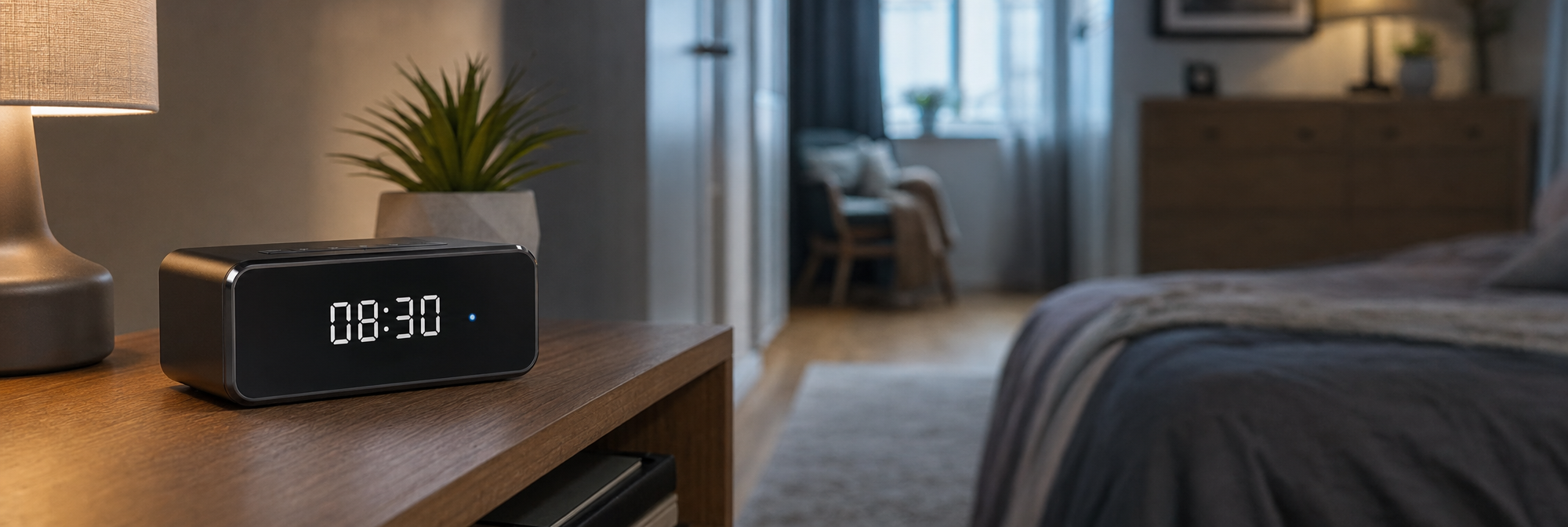
Not every indoor observation requirement calls for a visibly installed security camera. In a room where a clock already has a natural place—on a bedside table, shelving unit, desk, reception counter or cabinet—the 1080p Full HD spy camera alarm clock wi fiip is a particularly focused format. It combines a familiar alarm-clock form with 1080p Full HD video and Wi-Fi connectivity, answering a specific need: lawful visual oversight from one stable, room-appropriate location.
This is not a camera category to choose merely because it is discreet. It is the right choice when the object itself belongs naturally in the intended observation area and when the scene can be addressed from a fixed, considered point. The format matters as much as the resolution: a clock is at home in a room where a small, permanent surface object makes sense; it is not intended to imitate every kind of interior device or replace a conventional security installation.
At Europe-Connection, we recommend starting with the room and the observation objective. Once the desired scene has been clearly identified, the alarm-clock format becomes easy to assess: does a clock naturally sit at the location from which the relevant area is visible? If so, this 1080p Wi-Fi model provides a coherent, compact route to discreet indoor video coverage.
Why the alarm-clock format is more than a concealment choice
An alarm clock is a static object. That simple characteristic is valuable in an indoor video setup. Rather than treating the camera as a device that must be repeatedly moved, the format encourages a fixed point of observation and a defined scene. A bedside table, shelf or desk becomes part of the installation logic.
For authorised use in a private home, managed property or professional premises, that stable position can help focus the system on a practical question: what happens in this particular part of the room? For example, the relevant area may be an entrance into a privately controlled room, a reception-facing counter, a cabinet zone, or a clearly defined interior circulation point. The goal is not to make an entire building visible from one device. It is to place the device where an alarm clock is credible and where a specific visual area matters.
This is where an alarm-clock camera differs from an overt camera installation. Conventional video surveillance is often selected for broad, visible coverage across entrances, exterior approaches or several rooms. The alarm-clock format is more selective. It belongs in an indoor environment and supports a more contained observation plan, with the camera treated as one carefully positioned element rather than as a universal answer to every security requirement.
The object’s familiarity also has a design benefit. A room fitted out with furniture, personal items and day-to-day equipment usually looks more coherent when the observation device has an obvious reason to be there. An alarm clock is therefore a strong product format for locations where a clock is already expected—not an excuse to place an object where it makes no practical sense.
1080p Full HD: the right specification for reviewing an indoor scene
The product’s 1080p Full HD specification is central to its proposition. For a fixed indoor scene, Full HD is a useful resolution class because the purpose is generally to review visible activity within a defined area, rather than to spread limited image detail across an excessively wide room. The key is to match the clock’s placement to the scene that needs to be seen.
Resolution cannot compensate for poor positioning. A camera aimed from an arbitrary corner, blocked by furniture, or directed across an unnecessarily large space will not deliver the same practical value as one installed with a clear, realistic view of the relevant zone. With this model, make the clock position do useful work: choose a stable surface, avoid visual obstruction from ornaments or tall objects, and consider what routine movement will look like from that exact point.
In product selection terms, 1080p Full HD creates a sensible balance for an indoor, fixed-view requirement. It makes this camera a more appropriate choice for a defined room scene than a product selected only for physical miniaturisation. Where the room naturally supports a clock-sized object, the form factor and Full HD designation belong together: a familiar device, located at a credible height and orientation, covering a purposeful section of the space.
Think in scenes, not in room labels
“Bedroom,” “office” and “reception” are not observation plans by themselves. The important question is the scene within that room. In a home setting, that might be a doorway or an area around personal property. In a business setting, it might be a controlled stock point, a reception desk or the approach to a protected cabinet. In a managed property, it may be an entry point within an area where monitoring is authorised and transparently managed.
Defining the scene before installation avoids a common mismatch: choosing a discreet object because it is discreet, then expecting it to solve a coverage problem that actually needs a different camera category or multiple viewpoints. Europe-Connection’s product selection approach is deliberately more disciplined. Start with the scene, then choose the object format that belongs in it.
Wi-Fi connectivity suits rooms that are already part of a connected environment
Wi-Fi is the second defining specification of this alarm-clock camera. It places the product naturally in a connected indoor environment, rather than in an isolated outdoor location or a vehicle-based deployment. The installation should therefore be planned around the intended room and its Wi-Fi environment from the outset.
For this type of device, Wi-Fi is not an afterthought added once the clock is on a table. It is part of the reason to select the product. A room-based setup should be evaluated as a complete arrangement: the clock has a natural position, the relevant scene is visible from that position, and the location is part of the premises’ Wi-Fi environment. This prevents an unhelpful separation between physical placement and connectivity planning.
It also distinguishes this model from a 4G spy camera. A 4G format addresses a different deployment context, particularly where cellular connectivity is the selected route for a location. The 1080p Wi-Fi alarm-clock camera is the more coherent choice where the observation point is indoors, static and already associated with Wi-Fi-based premises connectivity.
Before committing to a location, decide where the clock will live on a day-to-day basis. A bedside table may offer a natural object position but not necessarily the scene you need. A shelf may offer a stronger view but only if the clock remains believable in that room layout. The best installation is the one in which the object, the target area and the Wi-Fi environment all align without forcing the room to become something it is not.
Where this product earns its place
We select the alarm-clock format for indoor assignments where discretion is relevant but visual coherence is non-negotiable. It is especially suited to a lawful observation need with a stable, furniture-based position. The following situations illustrate the product logic:
- A private interior space: a clock-format camera can be integrated into a room where the user has the right to monitor a defined area for security, property protection or care-related oversight conducted lawfully.
- An authorised office or reception area: where a desktop or shelf clock is already a credible part of the working environment and the observation objective is limited to a specific point within the premises.
- A controlled property-management setting: where equipment is deployed by the party responsible for the space, with appropriate notice, access controls and data-handling procedures.
- A fixed indoor asset point: where a small object placed on furniture provides a more natural visual presence than an overt camera enclosure.
These are not interchangeable scenarios. Each requires the installer to identify a legitimate purpose, select a proportionate field of observation and manage captured material responsibly. The camera’s discreet physical format makes that discipline more important, not less. Use it only in locations where monitoring is lawful and where people’s privacy rights are respected. For the legal framework applicable to your jurisdiction and use case, consult our spy camera laws resource.
A practical placement brief for an alarm-clock camera
The strongest installation begins with a short placement brief. This is not a generic installation manual; it is a way to decide whether this precise product format is appropriate before the clock reaches the room.
- Name the observation point. Define the doorway, desk, cabinet, counter or circulation area that has a legitimate reason to be observed.
- Select the natural clock surface. Choose a stable table, shelf or furniture top where an alarm clock belongs as part of the room’s normal use.
- Check the everyday sightline. Look at the scene from the clock’s position with the room as it is actually used: chairs, lamps, decorative objects and routine movement all affect the usefulness of the view.
- Keep the purpose proportionate. Limit the monitored scene to what is relevant to the authorised security or management objective.
- Plan the connected environment. Because this is a Wi-Fi model, include Wi-Fi in the location decision rather than treating it as a separate technical detail.
- Set governance before use. Establish who is authorised to access video, why it is being retained, and how it will be handled within the applicable rules for the premises.
These decisions are what turn a product specification into a useful deployment. A 1080p Wi-Fi camera in an alarm-clock format is at its best when it is positioned intentionally, not simply hidden.
How it compares with other camera formats
The right comparison is not “better” versus “worse,” but “right environment” versus “wrong environment.” A hidden spy camera category includes multiple everyday-object formats, each designed for a different visual setting. The alarm-clock format is the relevant one when a surface clock makes immediate sense in the room.
By contrast, an outdoor camera format is chosen for exterior observation conditions and installation points. A trail-camera-style product such as the 1080p sd trail camera belongs to a very different assignment: outdoor or nature-oriented fixed observation rather than a furniture-based indoor location. Selecting an alarm-clock device for an exterior setting, or selecting an outdoor camera for a bedside or desk environment, ignores the value of choosing equipment that fits its surroundings.
Likewise, users seeking an ultra-compact object for a very small installation point may be better served by the broader mini spy camera range. The reason to choose the alarm-clock product is not that it is the smallest possible camera. It is that its familiar object format can make a fixed indoor position practical and visually coherent.
The product decision: choose the room first
The 1080p Full HD Wi-Fi alarm clock spy camera is a specialist indoor product with a clear identity. Its 1080p Full HD video, Wi-Fi connectivity and alarm-clock format make it a strong choice for a lawful, fixed observation point in rooms where a clock naturally belongs.
Choose it when you can answer three questions positively: is there a legitimate and proportionate reason to observe this precise area; does an alarm clock genuinely fit the chosen surface and room; and is the location part of the Wi-Fi environment you intend to use? When those elements align, this product offers a neat, deliberate solution rather than a generic camera compromise.
Explore the spy camera range for complementary formats, and use our spy camera guide when your project requires a broader comparison of camera types and lawful deployment considerations.
Frequently Asked Questions
What is the 1080p Wi-Fi alarm clock spy camera designed for?
This camera is designed for lawful, fixed indoor observation in a defined part of a room. It combines an alarm-clock format, 1080p Full HD video and Wi-Fi connectivity. It is most appropriate where a clock naturally belongs on a bedside table, desk, shelf, reception counter or cabinet, and where that position provides a useful view of a specific area.
Is an alarm clock spy camera intended to monitor an entire building?
No. The alarm-clock format supports a selective observation plan focused on a particular indoor scene, such as a doorway, desk, cabinet area, counter or interior circulation point. It is not presented as a universal solution for broad coverage of multiple rooms, exterior approaches or an entire building. Larger or different surveillance requirements may need another camera category or multiple viewpoints.
Why does fixed placement matter for this type of camera?
An alarm clock is a static object, so it encourages a stable observation point and a clearly defined scene. A bedside table, shelf or desk becomes part of the installation plan. The camera should be placed where the relevant area is visible, rather than moved repeatedly. Its practical value depends on intentional positioning, a realistic sightline and a surface where a clock belongs naturally.
What does 1080p Full HD provide in an indoor setup?
1080p Full HD is suited to reviewing visible activity within a defined indoor area. It is most useful when the clock is placed to cover a purposeful section of the room, rather than aimed across an excessively wide space. Resolution cannot correct poor positioning: furniture, ornaments, tall objects and an arbitrary camera angle can all reduce the usefulness of the view.
How should I choose the right location for an alarm clock camera?
Start by identifying the precise area that has a legitimate reason to be observed, such as a doorway, cabinet, desk, counter or circulation point. Then choose a stable furniture surface where an alarm clock fits the room’s normal use. Check the everyday view from that position, including chairs, lamps, decorative items and routine movement, before deciding on the location.
Why is Wi-Fi part of the placement decision?
Wi-Fi is a defining feature of this model, so the intended room should already be part of the premises’ connected environment. Connectivity should be considered alongside the physical placement and required view, rather than as a separate detail after installation. The most coherent arrangement is one where the clock has a natural location, the relevant scene is visible and the site fits the intended Wi-Fi environment.
When is a Wi-Fi alarm clock camera more suitable than a 4G spy camera?
A Wi-Fi alarm clock camera is the more coherent option when the observation point is indoors, static and associated with the premises’ Wi-Fi connectivity. The article distinguishes this from a 4G spy camera, which addresses a different deployment context where cellular connectivity is the selected route for a location. The choice should reflect the environment and connectivity plan.
Which indoor settings can suit an alarm clock spy camera?
The format can suit a private interior space, an authorised office or reception area, a controlled property-management setting, or a fixed indoor asset point. In each case, the clock must be credible within the room and the monitoring purpose must be legitimate and proportionate. Managed settings also require appropriate notice, access controls and data-handling procedures.
What privacy and legal considerations apply to this camera?
Use the camera only where monitoring is lawful and privacy rights are respected. Before use, identify a legitimate purpose, limit observation to the relevant area and manage captured material responsibly. Establish who may access video, why it is retained and how it will be handled under the applicable rules for the premises. The discreet format makes this discipline particularly important.
Is this alarm clock camera suitable for outdoor use?
No. This format is intended for furniture-based indoor observation, where an alarm clock naturally fits the surroundings. Outdoor camera formats are selected for exterior observation conditions and installation points. A trail-camera-style product is also intended for a different purpose: fixed outdoor or nature-oriented observation rather than a bedside, shelf or desk location.
Should I choose this model if I need the smallest possible camera?
Not necessarily. The main reason to select this product is its familiar alarm-clock format for a coherent fixed indoor position, not minimum physical size. If the installation point is very small and requires an ultra-compact object, the broader mini spy camera range may be more appropriate. Choose the alarm-clock format when a surface clock genuinely suits the room and observation point.
What three questions should I answer before choosing this product?
First, confirm that there is a legitimate and proportionate reason to observe the precise area. Second, confirm that an alarm clock genuinely fits the chosen surface and room. Third, confirm that the location belongs to the Wi-Fi environment you intend to use. When these conditions align, the model provides a deliberate option for fixed indoor observation.



Comments (0)
Post a comment