
- Spy camera, mini camera and hidden camera: what is the difference?
- How does a spy camera work?
- Recording and live viewing are separate features
- Your phone acts as the viewing screen
- Wi-Fi spy camera, 4G or no Internet: which should you choose?
- Wi-Fi spy cameras
- Memory-card cameras
- 4G cameras
- Comparison: three ways a spy camera can work
- What does a camera hidden inside an object look like?
- Full HD, 4K and field of view: understanding image quality
- MicroSD or cloud: where is the footage stored?
- How many hours fit on a memory card?
- Is cloud storage compulsory?
- Battery life: how long can a spy camera record?
- Motion detection, AI and night vision: what do these features do?
- Motion detection
- Artificial intelligence analysis
- Night vision
- Using a spy camera at home: privacy and UK rules
- How to choose a spy camera: seven checks before buying
- Protect access to your camera and recorded footage
- Further reading
- FAQ: common questions about spy cameras
A spy camera is a small camera, or a camera integrated into an object, designed to record with a compact and discreet appearance. Depending on the model, it stores video on a memory card, sends images to a phone, or does both. Terms such as hidden camera, mini camera and discreet camera describe related formats, but do not necessarily mean the same features.
For a consumer, the useful question is what the device actually allows you to do: view a space remotely, retrieve a recorded event, or check a private entrance while respecting people's privacy. Wi-Fi, 4G, batteries, microSD cards and night vision can seem confusing at first. This guide explains the differences so you can compare specifications with realistic expectations.
Spy camera, mini camera and hidden camera: what is the difference?
“Spy camera” is a commercial description, rather than a separate video technology. The device uses a lens, an image sensor and processing electronics, just like a conventional security camera.
- Mini camera: this describes the small dimensions. The camera may still be fully visible.
- Hidden camera: the lens and electronics are integrated into a housing or an object.
- Security camera: this describes the observation and protection function, regardless of the physical format.
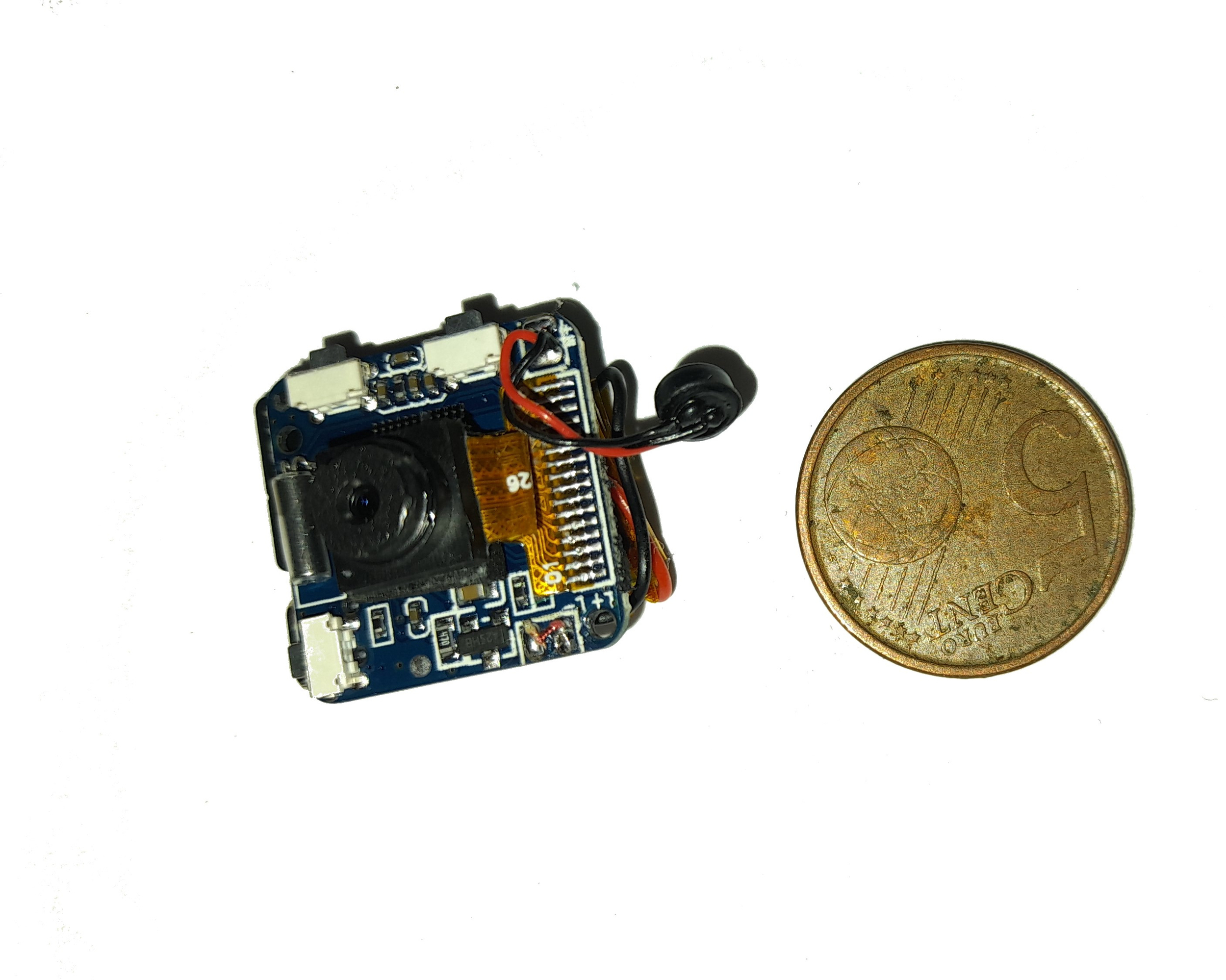
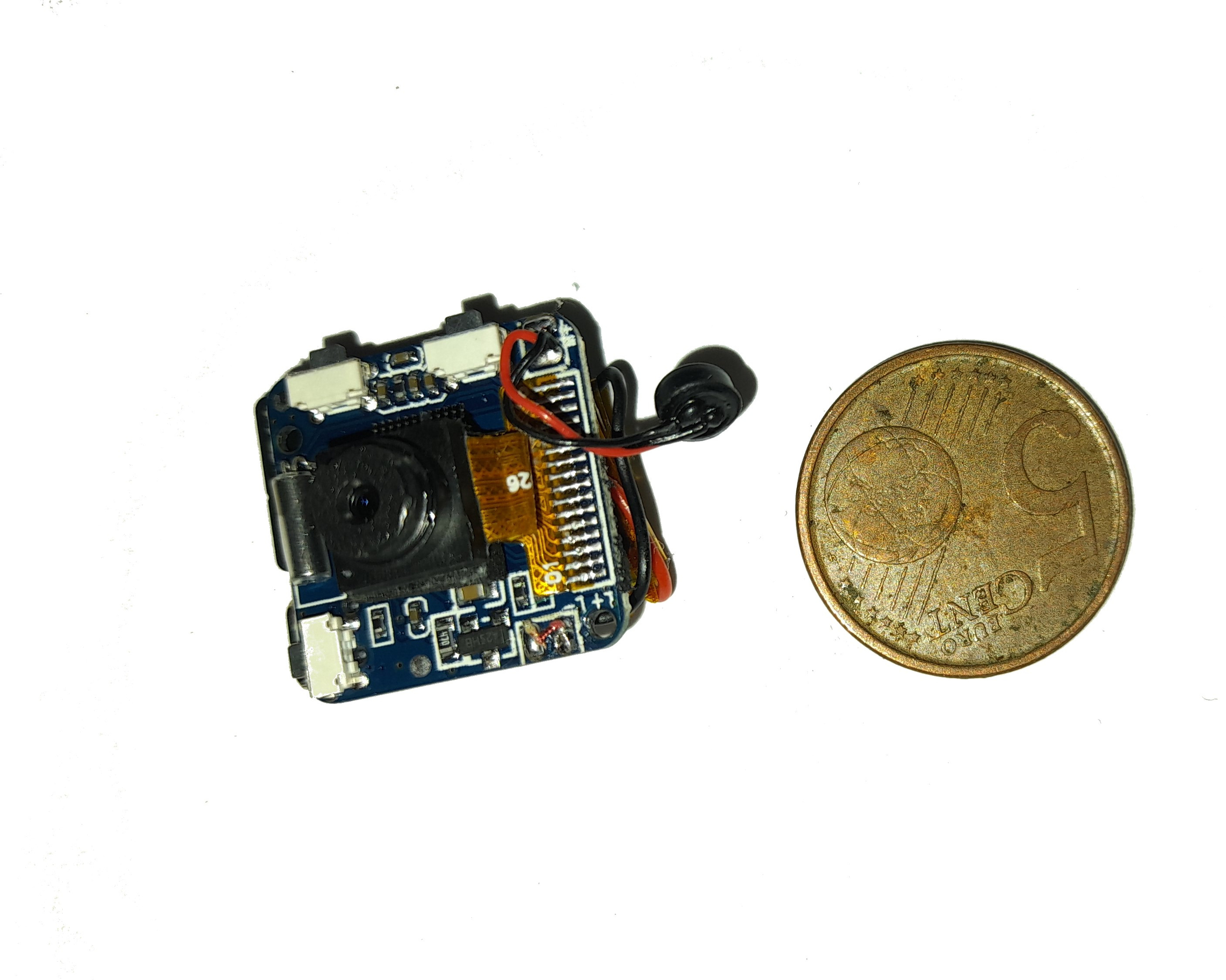
In the photograph, the 50-cent coin provides a size reference for a miniature module. A finished device can be larger once the housing, power supply and storage are included. A discreet design does not remove your responsibilities towards people being recorded.
How does a spy camera work?
The process has four main stages: capture the image, process it, record or transmit it, and make it available for viewing. Light passes through the lens. The sensor converts it into digital information. The electronics then produce compressed video, with quality determined by the components and settings.
Recording and live viewing are separate features
A camera can show a live picture without automatically saving a video. Conversely, a memory-card camera can record without an Internet connection. Before buying, check remote live viewing, local storage and playback of recorded footage as separate specifications.
Your phone acts as the viewing screen
With a compatible connected camera, an app usually lets you see the picture, change some settings and sometimes receive notifications. The exact options vary. Reading the microSD card remotely, downloading a clip, setting recording schedules or deleting files remotely are not available on every device.
Use three questions when comparing products: where is the video stored, how do you access it, and how is the camera powered? This keeps storage, connectivity and battery life from being confused with one another.
Wi-Fi spy camera, 4G or no Internet: which should you choose?
The connection type mainly determines how you access images. On its own, it does not tell you the video quality or guarantee that recording is included.
Wi-Fi spy cameras
A Wi-Fi spy camera connects to a compatible wireless network. To view the live picture away from home, that network generally needs Internet access and the camera must support remote viewing. Wi-Fi coverage at the intended location matters as much as your broadband speed.
Some devices support only 2.4 GHz Wi-Fi; others also support 5 GHz. Check the product information and instructions. A direct connection between the camera and phone, sometimes called AP mode, provides nearby access. It does not mean you can view the camera from anywhere.
Memory-card cameras
A camera designed for standalone local recording saves clips to microSD or built-in memory. It can work without Internet, but retrieval depends on the product: remove the card, connect by USB, or use a supported local connection. Do not assume it also sends alerts to your phone.
4G cameras
A 4G spy camera uses a mobile network instead of the property's broadband connection. It generally requires a suitable SIM, a data plan and adequate coverage. Check supported network bands, your operator's conditions and the app's available functions. Watching live video uses mobile data.
Comparison: three ways a spy camera can work
| Camera type | How you access footage | What you need | What to check |
|---|---|---|---|
| Local recording to a memory card | Playback after retrieving the files or through a supported local connection. | A compatible memory card and a power source. | Supported capacity and how recorded files are retrieved. |
| Connected Wi-Fi camera | Remote live viewing if supported by the camera and app. | A compatible Wi-Fi network with an Internet connection. | Signal at the location, storage and features available without a subscription. |
| 4G camera | Remote viewing over the mobile network, depending on the model. | A SIM, data plan and adequate mobile coverage. | Network compatibility, data use and real battery life. |
What does a camera hidden inside an object look like?
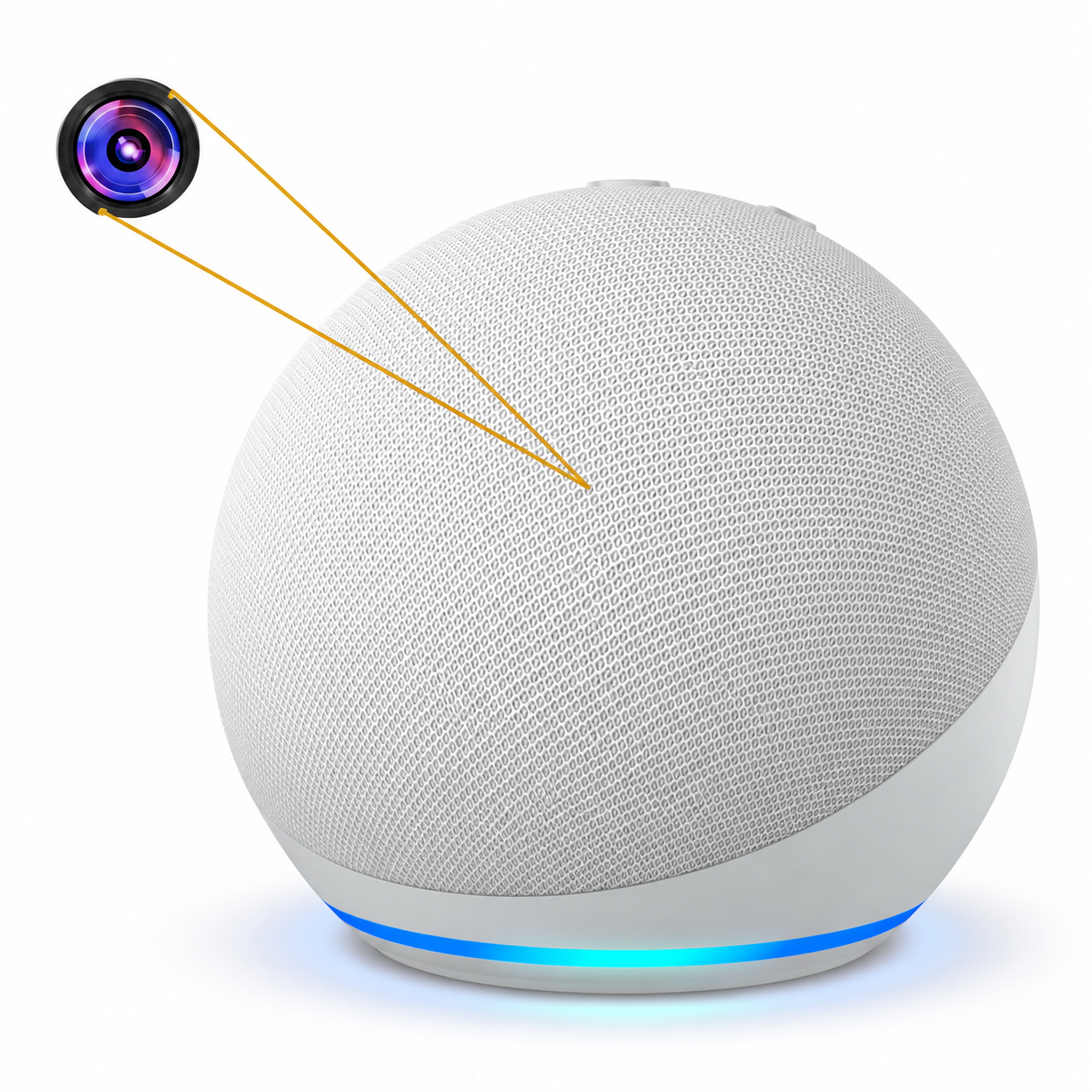
A camera can be integrated into a clock, a lamp or another housing. The object contains a video module whose lens still needs an unobstructed view. The illustration shows an example built into a speaker, with an enlarged detail indicating the lens position.
The object's appearance does not reveal every feature. A mains-powered housing does not guarantee that the camera has a backup battery. Nor should you assume that every original function of the object remains available after integration. Read the description for the particular model.
Compare the overall dimensions, field of view, access to the memory card and operating conditions. A discreet device remains electronic equipment that needs to be configurable and maintainable.
Full HD, 4K and field of view: understanding image quality
Resolution describes the number of pixels in the image. Full HD 1080p means 1,920 × 1,080 pixels. 4K UHD means 3,840 × 2,160 pixels. Higher resolution can provide more detail, but results also depend on the sensor, lens, lighting and compression.
Pay particular attention to the resolution of the recorded file. A device may offer live viewing at one resolution and save video at another. Enlarging an image in software does not create detail that the sensor never captured.
The field of view determines how much of the scene is visible. A wide-angle lens covers a larger area, but a distant subject occupies fewer pixels. The right choice depends on the area you need to see and the distance of relevant details.
A sharp image of a stationary scene does not guarantee the same clarity when something moves. Look for specific information about motion, low-light performance and recording resolution, rather than relying on a single headline specification.
MicroSD or cloud: where is the footage stored?
MicroSD recording stores footage in the device itself. Check the maximum supported capacity, required formatting and recommended speed class in the instructions. A high-capacity card is useful only if the camera can handle it correctly.
How many hours fit on a memory card?
Recording time depends on video bitrate, recording mode and usable space. As an illustrative calculation, a constant 4 Mbit/s is approximately 1.8 GB per hour. A card advertised as 64 GB would therefore hold about 35 hours theoretically, before allowing for formatting, metadata and bitrate changes. This is not a guaranteed recording duration for a particular product.
When supported and enabled, loop recording replaces the oldest files once the card is full. Export an important clip before it is overwritten. A long recording session may also be split into several files.
Is cloud storage compulsory?
That depends on the service. Online storage may be optional, paid, or associated with particular features. A free app does not mean cloud storage, recording history or advanced analysis is also free. Check retention periods, charges and download options before choosing.
Battery life: how long can a spy camera record?
There is no universal recording duration. Battery life depends on capacity, the module's power consumption, connectivity, night vision and the selected operating mode. Temperature and battery condition can also affect results.
An advertised standby time is not the same as continuous recording time. A device that wakes only for an event may use less power than one constantly recording and transmitting. That saving requires a genuine supported sleep mode.
A mains-powered camera can operate longer, but still depends on its power supply, available storage and the limits in its instructions. Check separately whether it includes a backup battery and what that battery powers during an outage.
“Wireless” often describes the video connection. A Wi-Fi camera may still need a power cable. Conversely, a battery-powered camera can record to a card without transmitting any video.
Motion detection, AI and night vision: what do these features do?
Motion detection
This may trigger a recording, an alert, or both. Some systems analyse changes in the image; others use a dedicated sensor. Shadows, lighting changes or animals can cause triggers, depending on the technology and settings.
Check whether you can adjust sensitivity, limit the monitored area or set operating schedules. With an automatically waking camera, also check the start-up delay: it may not record the very beginning of an event.
Artificial intelligence analysis
Depending on the model, AI can help distinguish event types, such as the presence of a person, or provide a scene description. These features may require Internet access and a cloud service. They can make mistakes and do not guarantee that every event will be detected.
Night vision
Good low-light sensitivity does not mean a camera can see in complete darkness. Recording without visible light requires suitable infrared illumination or another supported solution. Check the stated range and the conditions used to measure it.
Nearby or reflective surfaces can affect infrared images, particularly through glass. Assess night vision under actual operating conditions while respecting the area you are lawfully allowed to capture.
Using a spy camera at home: privacy and UK rules
A common need is to check a private entrance or retrieve footage relating to your possessions. First define the area you need to see and who might appear in it. A discreet camera is not permission to intrude on another person's private life.
In the UK, the ICO's guidance on home CCTV explains that capturing images or audio beyond your property boundary brings data-protection obligations. These include a clear purpose, limiting what is captured, informing people and deleting footage regularly.
Protect intimate spaces and consider visitors, neighbours and anyone working in the home. Audio recording needs separate consideration. Requirements vary between countries and situations; ownership of a property does not give an unrestricted right to secretly monitor other people.
How to choose a spy camera: seven checks before buying
For a first purchase, compare specifications against a practical situation: viewing remotely, saving a clip, or checking a private entrance. This makes it easier to choose features you will actually use.
- Viewing: remote live video, nearby access, or playback after retrieving the card?
- Connection: compatible Wi-Fi coverage, a usable 4G signal, or recording without a network?
- Power: real recording duration, charging method and behaviour during a power cut?
- Saved image: file resolution, field of view and performance in the available light?
- Memory: supported capacity, loop recording and ease of exporting clips?
- App and costs: phone compatibility, free functions, cloud services and any data plan?
- Support: clear instructions, configuration assistance and precise warranty terms?
For example, if you want to review footage without Internet, choose a model explicitly designed for local recording. To view a space away from home, check the available connection and remote-viewing support. Battery life and respect for other people's privacy remain important in both cases.
Compare specifications in our spy camera, Wi-Fi spy camera, internal-memory and memory-card camera and 4G spy camera categories.
Protect access to your camera and recorded footage
A connected camera can capture personal images. Access security deserves as much attention as picture quality. Review the settings when you first configure the device.
- Replace default passwords and use a separate password for the app account.
- Install available security updates for the device, app and phone.
- Share access only with authorised people and review linked accounts.
- Protect your Wi-Fi network and check the cloud service's privacy settings.
- Before passing the device on, erase recordings and reset it following its instructions.
Careful configuration protects both the equipment and the images it stores.
Further reading
For another recording format, read our introduction to 1080p memory-card trail cameras. If your concern is protecting your privacy while travelling, see our guide to hidden cameras in holiday rentals.
Before buying, write down what you need to do, the connection available and the operating time you expect. Those details give you concrete criteria for checking every product description and help prevent one feature from being mistaken for a complete set of functions.
FAQ: common questions about spy cameras
A spy camera is a miniature camera or one integrated into an object for a discreet appearance. Depending on the model, it records to a memory card, transmits images remotely, or does both. The name does not guarantee Wi-Fi, night vision or any particular battery life.
Both can observe a space and record video. The main difference is usually the format: a spy camera is typically small or integrated into a discreet housing. Performance and lawful-use requirements depend on the model and the situation, not the name alone.
Yes, if it supports standalone recording to microSD or built-in memory. Footage is retrieved using the manufacturer's specified method. Live viewing and alerts away from the camera generally require a suitable Internet connection through Wi-Fi or a mobile network.
Yes, with a model that supports an app and video viewing. Access from elsewhere requires a suitable Internet or mobile connection at the camera. A nearby local connection does not guarantee remote access.
That depends on its power source. Wireless often refers to image transmission over Wi-Fi or a mobile network, while the camera itself may run on mains power. Battery models have limited operating time, which should be checked for actual recording.
Duration depends on power, battery capacity, video bitrate, storage and operating mode. Standby time is not continuous video time. With supported loop recording, older files can be replaced when the card fills up.
No. Live-view resolution can differ from saved-file resolution. Check the recording specification and whether the resolution is native or enlarged in software. Lighting, optics and compression also affect image quality.
No. Good low-light performance does not necessarily mean recording in complete darkness. Night vision depends on suitable equipment, such as infrared illumination, and its range. Verify this feature for the chosen model.
Not necessarily. Local recording may work without a subscription. Some cloud services, advanced analysis or online recording histories are paid. A 4G camera generally needs a mobile data plan. A free app does not make every option free.
You must respect privacy and applicable rules. Recording beyond your property boundary brings data-protection obligations under the ICO's home CCTV guidance. Limit capture, inform people where required and protect recordings. Owning the property does not give unrestricted permission to secretly monitor other people.



Comments (0)
Post a comment