
- JJN Digital WAM and EDD: what do they detect?
- WAM-X10 vs WAM-X10+: what changes in the compact RF detector?
- WAM-X25 vs WAM-X25+: how the tablet RF monitor evolves
- Detecting 6 GHz signals and analysing a network are different functions
- Bluetooth and battery life: two points to check before buying
- WAM-X10+ or WAM-X25+: which suits your work?
- EDD-24T vs EDD-24XT: easier access to inspection areas
- Is the 24XT more powerful?
- Should you replace an older JJN Digital device?
- Frequently asked questions about JJN Digital WAM and EDD
- Do the WAM-X10+ and X25+ detect every 5G frequency?
- Can an older WAM-X10 or X25 respond to a 6 GHz transmission?
- Can the WAM-X25+ find AirTags?
- Can an EDD detector find a microphone that is switched off?
- What is the main benefit of the EDD-24XT over the 24T?
- Official JJN Digital sources
Choosing between a JJN Digital WAM-X10 and WAM-X10+, a WAM-X25 and WAM-X25+, or the EDD-24T and EDD-24XT? Their names are similar, but the updates address different needs.
The WAM “+” versions add dedicated radio detection bands. The EDD-24XT mainly improves access to the surfaces being inspected through its telescopic pole and adjustable head. Understanding these differences helps you choose counter-surveillance equipment for the work you actually carry out.
This Europe Connection comparison is based on official JJN Digital product pages and datasheets reviewed on 8 October 2026. Performance figures are the manufacturer’s claims; our recommendations interpret the published specifications and are not the results of a comparative laboratory test.
JJN Digital WAM and EDD: what do they detect?
Before comparing generations, distinguish the two technologies. WAM devices monitor radio-frequency activity. They look for transmissions from devices such as GSM microphones, Wi-Fi cameras and trackers communicating over mobile networks. Their event history helps investigate brief, recurring transmissions.
EDD devices are non-linear junction detectors (NLJDs). They transmit a signal and examine harmonic responses from electronic components. This allows them to search for a circuit even when the device is switched off or has no power.
This matters during a TSCM survey: a silent standalone recorder may escape an RF transmission search, while an NLJD can reveal its electronic presence. A positive response still needs interpretation and physical verification; it does not by itself prove that a spy device is present.
WAM-X10 vs WAM-X10+: what changes in the compact RF detector?
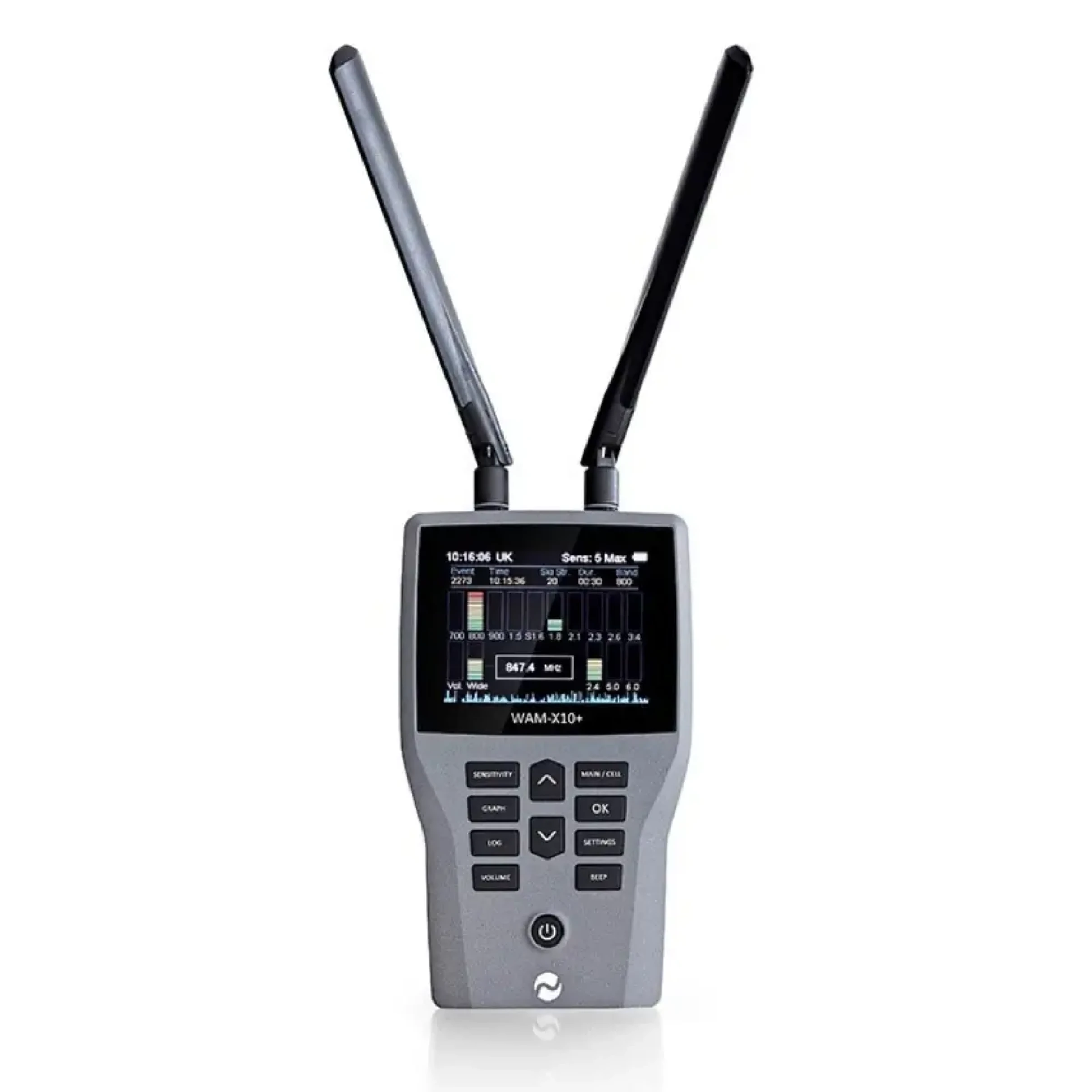
The WAM-X10 family prioritises portability. The X10+ retains a 3.5-inch screen, a weight of 500 g and a 4,000-event log. The main changes concern dedicated detection bands and charging.
| Feature | WAM-X10 | WAM-X10+ |
|---|---|---|
| Broadband RF detection | 10 MHz to 14 GHz | 10 MHz to 14 GHz |
| Frequency counter / display | Up to 6 GHz | Up to 6 GHz |
| Cellular detection | 2G/3G/4G/5G, depending on region and covered bands | 2G/3G/4G/5G, depending on region and covered bands |
| Dedicated Wi-Fi / RF bands | 2.4 and 5 GHz | 2.4, 5 and 6 GHz |
| Satellite phones / dedicated band | No dedicated band stated | Dedicated L-band at 1.6 GHz |
| Screen / weight | 3.5 inches / 500 g | 3.5 inches / 500 g |
| Event log / export | 4,000 events / USB flash drive | 4,000 events / USB flash drive |
| Stated battery life | Up to 8 h | Up to 8 h |
| Charging | Micro-USB | USB-C |
Why choose the WAM-X10+? Dedicated monitoring of 6 GHz activity or L-band satellite phones is a concrete reason to upgrade. USB-C also makes charging easier with commonly available accessories.
The original WAM-X10 already has broadband RF coverage that includes 6 GHz. The X10+ adds a dedicated detection channel without raising the 14 GHz upper limit. The published documents do not establish a general increase in detection range: distance depends on the signal and the environment.
Both models monitor radio activity in Wi-Fi/Bluetooth bands. Their datasheets do not describe the detailed network analysers found on the X25 models, so the same SSID or MAC-address listings should not automatically be assumed.
WAM-X25 vs WAM-X25+: how the tablet RF monitor evolves
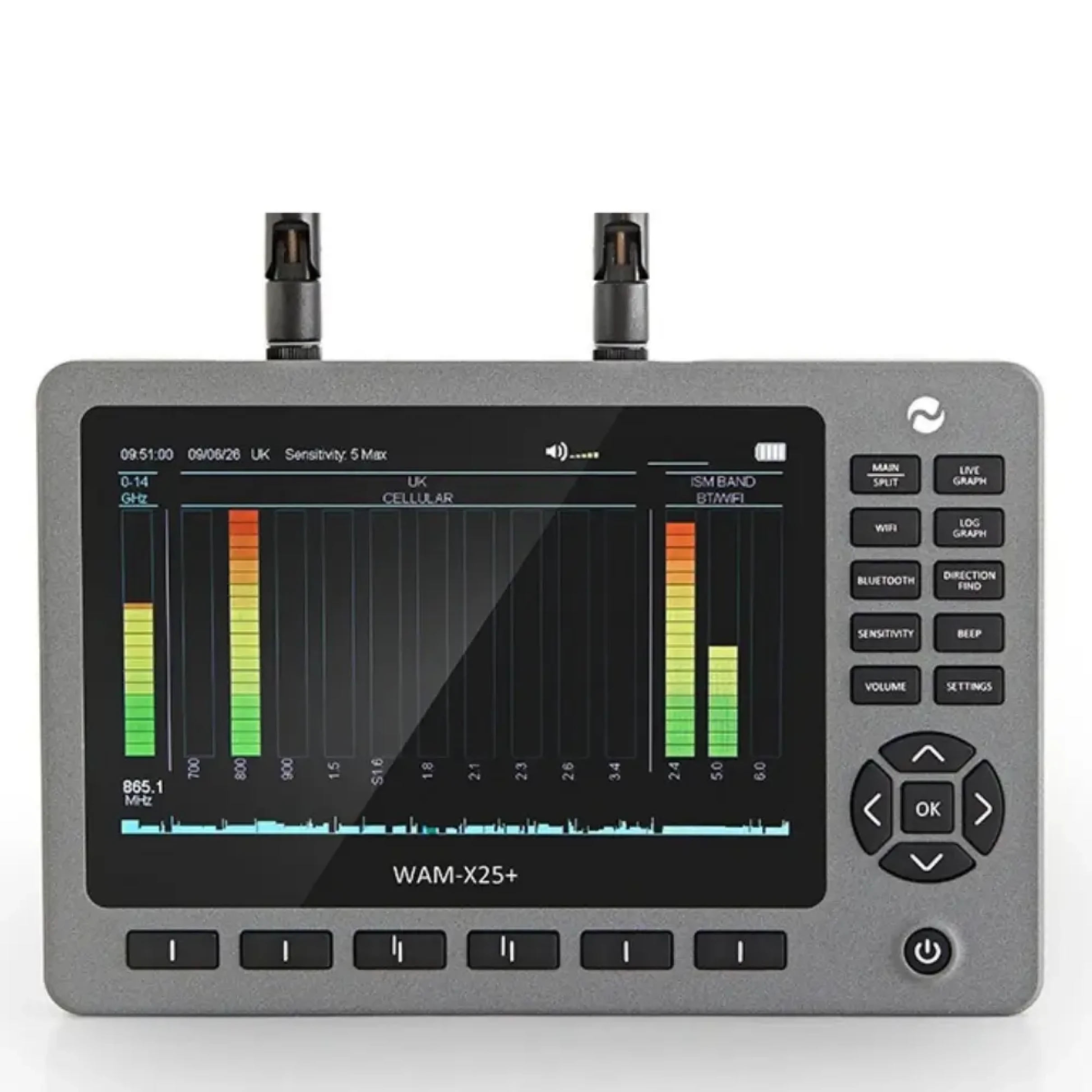
The WAM-X25 and WAM-X25+ combine a 7-inch screen with Wi-Fi and Bluetooth analysis tools. They also offer directional searching and a larger event log than the X10 series.
| Feature | WAM-X25 | WAM-X25+ |
|---|---|---|
| Broadband RF detection | 10 MHz to 14 GHz | 10 MHz to 14 GHz |
| Frequency counter / display | Up to 6 GHz | Up to 6 GHz |
| Cellular detection | 2G/3G/4G/5G, depending on region and covered bands | 2G/3G/4G/5G, depending on region and covered bands |
| Dedicated Wi-Fi / RF bands | 2.4 and 5 GHz | 2.4, 5 and 6 GHz |
| Wi-Fi network analyser | 2.4 and 5 GHz | 2.4 and 5 GHz |
| Satellite phones / dedicated band | No dedicated band stated | Dedicated L-band at 1.6 GHz |
| Bluetooth analyser | Yes | Yes; AirTags and BLE beacons explicitly listed |
| Directional searching | Yes | Yes |
| Event log / export | 10,000 events / USB flash drive | 10,000 events / USB flash drive |
| Screen / weight | 7 inches / 1 kg | 7 inches / 1 kg |
| Stated battery life | Up to 8 h | Up to 6 h |
| Charging | Micro-USB | USB-C |
| Additional LF antenna | Not mentioned in the kit | 0–800 MHz antenna included |
Detecting 6 GHz signals and analysing a network are different functions
The WAM-X25+ adds a dedicated 5,925–7,125 MHz band. Its detailed Wi-Fi analyser, however, remains documented for 2.4 and 5 GHz. This does not imply that it displays SSIDs and MAC addresses for every 6 GHz transmission.
Bluetooth and battery life: two points to check before buying
The X25+ documentation explicitly mentions AirTags and other BLE beacons. The original X25 already has a Bluetooth analyser, but its documentation does not establish identical support for those beacons.
The newer model also specifies shorter battery life: up to 6 hours rather than 8. For an existing owner, upgrading should depend on the usefulness of the additional functions, without assuming that every specification improves.
WAM-X10+ or WAM-X25+: which suits your work?
Both families share the same 14 GHz broadband RF ceiling. The choice therefore cannot be reduced to which device reaches the highest frequency.
For work where low weight matters, the WAM-X10+ weighs 500 g and offers up to 8 hours of stated battery life. To examine networks and review a larger log on a bigger screen, the WAM-X25+ offers Wi-Fi/Bluetooth analysers, a 7-inch screen and 10,000 events, at a weight of 1 kg.
A technician who travels frequently may favour the X10 series. A team needing to document and compare observed activity may find the X25 more useful. These recommendations follow the published functions and do not presume relative sensitivity across all receiver channels.
EDD-24T vs EDD-24XT: easier access to inspection areas
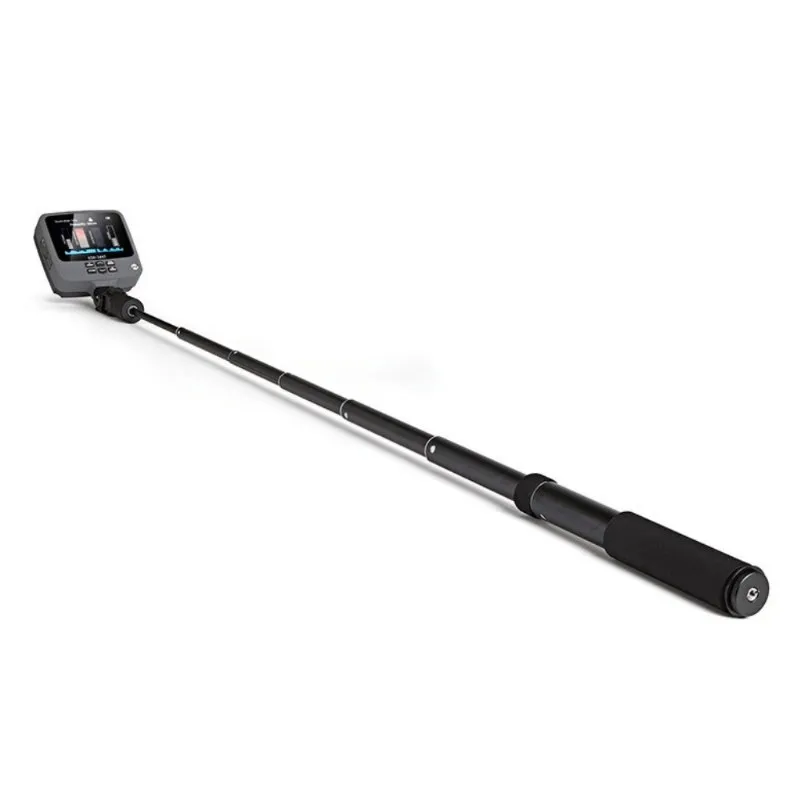
The EDD-24T and EDD-24XT use the same NLJD method to search for electronic circuits. The 24XT adds a telescopic pole and adjustable head to reach less accessible surfaces.
| Feature | EDD-24T | EDD-24XT |
|---|---|---|
| Technology | Handheld NLJD | NLJD with pole |
| Transmission | 2.400–2.425 GHz | 2.400–2.425 GHz |
| Harmonic reception | 4.8 and 7.2 GHz | 4.8 and 7.2 GHz |
| Stated transmitter / radiated power | Up to 1 W / 4 W | Up to 1 W / 4 W |
| Stated sensitivity | Better than −120 dBm | Better than −120 dBm |
| Unpowered circuits | Detection possible | Detection possible |
| Silicon / metal indicator | Yes, probability indicator | Yes, probability indicator |
| Pole | No | Adjustable from 30 to 140 cm |
| Adjustable head | Not stated | 5 positions over 90° |
| Device weight | 700 g | 870 g with pole fitted |
| Battery life at minimum / maximum TX power | 4.5 h / 2 h | 4.5 h / 2 h |
| Complete kit weight | 2 kg | 3 kg |
Is the 24XT more powerful?
The datasheets publish the same power and sensitivity figures. The stated 4 W is radiated power at the antenna, distinct from 1 W transmitter power. These figures do not demonstrate superior detection performance for the 24XT.
Its advantage is practical: the pole and adjustable head help approach high or awkward areas. Two 200 g counterweights are supplied to balance the assembly; fitting them increases the weight being handled.
The 24T can suit close inspection of objects or furniture. The 24XT becomes more useful when height or approach angle makes inspection difficult. A 140 cm pole does not mean a 140 cm detection range: it brings the antenna closer to the target.
Should you replace an older JJN Digital device?
Replacing a device makes sense when the update solves a problem encountered in the field. With a WAM-X10 or X25, consider whether a dedicated 6 GHz band, satellite monitoring or the documented X25+ Bluetooth functions are necessary for your assignments. With an EDD-24T, consider how often you inspect high or hard-to-reach areas.
A newer device does not automatically make the previous one unusable. If the existing functions meet your needs, improving the inspection method may be more useful than changing generations. Combining a WAM RF monitor with an EDD NLJD, for example, searches for two different indicators: a transmission and an electronic presence.
Choose RF detectors and NLJD equipment according to the devices you are searching for, the locations being inspected, the battery life required and the level of analysis you need.
Frequently asked questions about JJN Digital WAM and EDD
Do the WAM-X10+ and X25+ detect every 5G frequency?
The stated compatibility applies within the covered bands and the selected region. The 14 GHz broadband limit means that not all millimetre-wave 5G bands are covered.
Can an older WAM-X10 or X25 respond to a 6 GHz transmission?
Its broadband range includes that frequency. The “+” models add a dedicated 6 GHz detector; this should not be confused with a complete absence of coverage on the earlier models.
Can the WAM-X25+ find AirTags?
JJN Digital lists them among devices supported by its Bluetooth analyser. This concerns detectable transmissions and does not guarantee finding every beacon in every situation.
Can an EDD detector find a microphone that is switched off?
It can search for the electronic circuits without a power supply. The result needs interpretation: detecting a semiconductor does not automatically identify the device’s function.
What is the main benefit of the EDD-24XT over the 24T?
Its pole and adjustable head make some surfaces easier to access. Published power and sensitivity figures are identical; a general increase in range has not been established.
Official JJN Digital sources
This comparison distinguishes manufacturer claims from our recommendations. The source documents were reviewed on 8 October 2026; actual battery life and detection results depend on operating conditions.



Comments (0)
Post a comment